
By levitating microparticles in a vacuum, we’ve created a tiny sensor of incredible sensitivity. Our use of cutting-edge technology inspired by how the brain interprets vision allows us to control the motion of the sensors at high-speed, which through a process of cooling would allow us to exploit properties of quantum mechanics to make our sensor even more sensitive."
Professor James Millen
02 December 2025
New levitating sensors could pave way to dark matter detection and quantum sensing
A new type of sensor that levitates dozens of glass microparticles could revolutionise the accuracy and efficiency of sensing, laying the foundation for better autonomous vehicles, navigation and even the detection of dark matter.
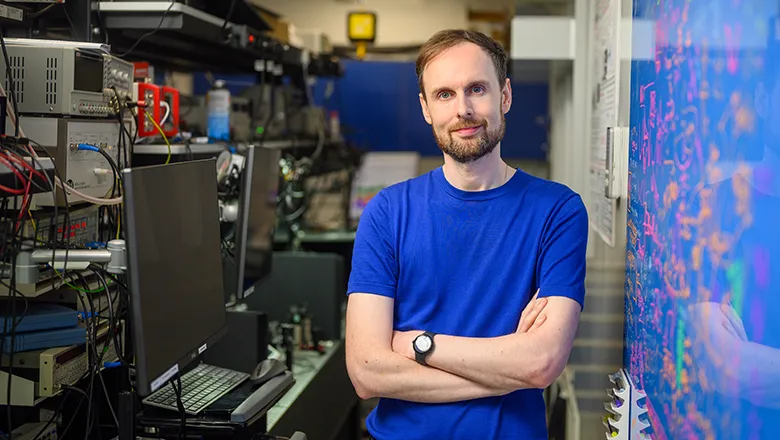
Using a camera inspired by the human eye, scientists from King’s College London believe they could track upwards of 100 floating particles in what could be one of the most sensitive sensors to date.
Levitating sensors typically isolate small particles to observe and quantify the impact of outside forces like acceleration on them. The higher the number of particles which could be disturbed and the greater their isolation from their environment, the more accurate the sensor can be.
By being able to both accurately track and control clouds made up of many sensors, the King’s design breaks the historical choice previous devices had between rapidly tracking a single object and slowly tracking many.
Professor James Millen, Professor of Physics at King’s and Director of the King’s Quantum research centre said “Often unseen, sensors lie at the heart of much of modern technology and science. More accurate sensors would mean that autonomous vehicles can find their way around far more accurately than before as they detect minute changes in acceleration and provide self-contained navigation systems that are not beholden to unreliable satellite connections.
“By levitating microparticles in a vacuum, we’ve created a tiny sensor of incredible sensitivity. Our use of cutting-edge technology inspired by how the brain interprets vision allows us to control the motion of the sensors at high-speed, which through a process of cooling would allow us to exploit properties of quantum mechanics to make our sensor even more sensitive. This would enable us to probe the incredibly weak forces involved in detecting gravitational waves or dark matter in the lab.”
Published in Nature Communications, the study uses a neuromorphic or brain-inspired Event Vision camera to detect the motion of an array of microparticles suspended in electromagnetic fields. By detecting only how the microparticles move, rather than taking video frames of everything in the field-of-view, the Event Vision camera gathers only the necessary information. Use of an AI algorithm then allows the researchers to track the motion of the particles both individually and collectively as a singular cloud, to understand all the forces acting on them. This allows for an unparalleled level of accuracy.
This approach produces a minimal amount of data, allowing the authors to generate real-time feedback signals to control the motion of each particle in the array. By controlling the motion of the microparticles, the researchers can reduce their energy, effectively cooling them and stabilising their motion.
In the future, our approach could help cool particles to below a thousandth of a degree above absolute zero, the lowest possible temperature allowed by quantum physics, eliminating the thermal noise and vibrations which get in the way of a sensor’s accuracy. This would produce a quantum sensor with an accuracy and sensitivity unparalleled by the classical technology we use today.”
Dr Yugang Ren, former Postdoctoral researcher at King’s
Due to the very low energy used to power these devices, the team believe there is significant room to scale up the number of particles the sensor levitates and integrate the technology onto chips.
Dr Yugang Ren, formerly a Postdoctoral researcher at King’s and first author of the study said “Because of the low power usage of both our imaging technology and the algorithms we use to track the sensors, implementation onto computer chips could be possible in the next five to ten years. This means everything from environmental monitoring to consumer electronics could benefit from more accurate sensing – whether that be of harmful gasses or keeping track of where we are.
“In the future, our approach could help cool particles to below a thousandth of a degree above absolute zero, the lowest possible temperature allowed by quantum physics, eliminating the thermal noise and vibrations which get in the way of a sensor’s accuracy. This would produce a quantum sensor with an accuracy and sensitivity unparalleled by the classical technology we use today.”
In this story
Professor of Physics