
26 October 2026
Dr Nathaniel Télémaque & Ben Haines
To explore this year's Black History Month theme in research at King’s, we spoke with Dr Nathaniel Télémaque from the King’s Geography department. Nathaniel is a North West London-born and raised visual artist, writer, and researcher. The Q&A explores the origins of his interest in photography, the power of documenting the everyday and the role photography has had in documenting community.
October marks Black History Month in the UK, an opportunity to celebrate, reflect on, and recognise the histories, achievements and contributions of Black British communities. This year's theme, Honouring Our Communities, highlights the collective strength, resilience and impact of Black communities across the country. To explore this theme in research at King’s, we spoke with Dr Nathaniel Télémaque from the King’s Geography department. Nathaniel is a North West London-born and raised visual artist, writer, and researcher.

Nathaniel’s research focuses on centring everyday Black experiences through collaborative photographic practices, making portraits with people and places as opposed to making portraits of them.
He combines his practice-based approaches to photography, soundscapes and film with human geography research techniques to co-produce a unique record of the everyday.
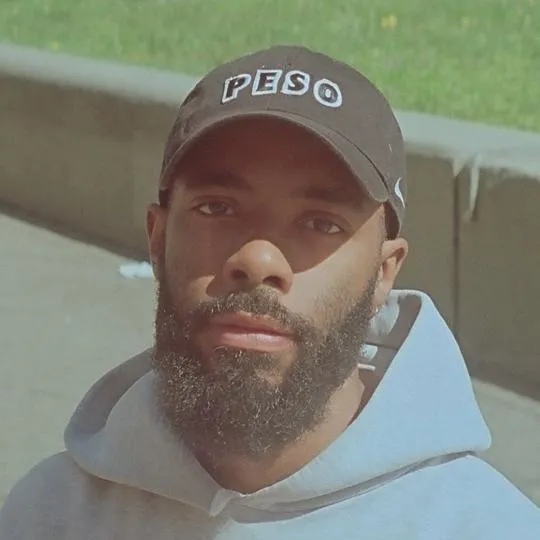
Photo Credit: Nathaniel Télémaque
1. What first drew you to photography, and how did it become part of your research and creative practice?
I think film was the gateway into photography. Seeing the way African American directors such as John Singleton and Spike Lee depict people and places, combining music, art and poetry made me realise that photography could be a way of trying to make my own depictions of the world. I am a self-taught photographer, and it became central to my practice-based PhD and my work with young adults in White City. It was a good way of marrying my creative interests with my intellectual curiosity of focusing on documenting the everyday. I stayed with photography because it is very accessible, and we are surrounded by it in our everyday lives.
2. This year's Black History Month theme is around honouring communities. What does community mean to you, both personally and through your work?
When we say the Black community, I feel we have to pluralise it as Black communities and be specific. We are not a monolith. I try to challenge the idea that there is a single, fixed community in any situation. It can sometimes be used as a buzzword, so in my work, I try to make site-specific projects with people and places, to avoid this, by recognising the range of different communities that someone might be a part of and experiences they might have. I also try to disperse my authorship. I ask people where and how they would like to be photographed, I even give them my camera.
Actually having interpersonal relationships with people from similar or different backgrounds is a powerful form of community. There is something important about meeting physically, creating work together and sharing it face to face.
So by recognising different communities I think this is a good way to highlight some of those more hidden histories or unknown histories that otherwise wouldn’t be part of a monolithic community narrative.
3. How has photography historically helped document and preserve Black British experiences and histories?
The fact that anyone can pick up a camera and make photographs has made photography a powerful medium for telling the histories, experiences and stories of different Black people in Britain.
For example, Charlie Phillips, who photographed the Notting Hill area throughout the 1950s and 1960s, got his first camera, a Kodak Retinette, given to him by an American soldier by chance and then taught himself photography by photographing his local area, which now means we have an archive of documentary photography for that time.
It wasn't just Charlie Phillips who did this. Through photography, you can see everyday aspects of Black British life that you might not see in mainstream media depictions. Photographers such as Vanley Burke, Eileen Perrier, Ingrid Pollard, Joy Gregory and Neil Kenlock have created records of everyday life, political movements, landscapes, celebrations and changing neighbourhoods.
Photography has the capacity to speak to past, present and future representations. It can teach people and raise awareness, while also allowing Black people to see themselves represented, which I feel is affirming.
4. Many of your projects focus on the everyday. Why do seemingly ordinary moments, objects and spaces matter when telling stories about Black lives and communities?
I like to focus on ordinary, everyday things because there is often a sensationalisation of Blackness in mainstream media and contemporary society. Sometimes I feel we are called to be extraordinary, when we are ordinary people like anybody else. Sometimes the societal pressure and scrutiny that gets put on individuals, when they’re singled out, is too great. The death of Professor Jason Arday is a tragic example of this.
By paying attention to the ordinary, it's the antithesis to the extraordinary, and allows us to focus on the journey and the process.
To me, it is more interesting to see what somebody had for breakfast, what they do day to day, or what their route between home and school is like. That is where the beauty of daily life is: in the ordinary conversation at the bus stop, the walk to work, or the sunlight that falls on your favourite spot.
Paying attention to those details creates a more rounded representation of people's lives.
5. What is one story or perspective about Black communities that you feel is often overlooked or misunderstood?
What is very dominant in the public narrative and popular culture is the London Black experience, rather than the wider Black British experience.
I want to see more stories from people in smaller towns, rural areas, Wales, Scotland and other regions. I really want to see what a Black British rural experience looks like.
When you decentre London, you also encounter a much longer and more varied history of Black presence in Britain, showcasing the histories that predate Windrush.
As much as I love the London experience, being a born and raised Londoner myself, when we focus on London only, we do not get to see enough pluralities. But, by expanding to ensure we share the breadth of experiences Black British people have beyond London, we get to see Black community with an I-E-S on the end (communities), instead of the Y.
View a sample of Nathaniels work

Want to learn more?
In this story
Lecturer in Geography and Social Justice