
Planting trees, growing communities: How King's gained 2000 trees
Nimi Dave explains how planting trees can not only boost nature and...
As a key part of our work tackling the ecological crisis, King's is committed to enhancing and protecting biodiversity on our campuses, halls of residence and sports grounds.
We have a predominantly urban estate, which offers special opportunities to enhance biodiversity and improve green spaces.
Biodiversity Net Gain (BNG) is an approach that ensures human activities leave biodiversity in a measurably better state than before. Although often associated with development projects, King's Sustainability Strategy applies this more broadly.
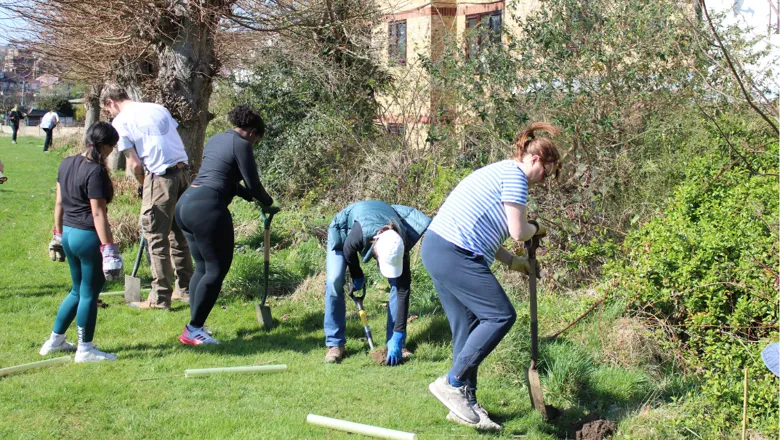
We have already made progress in this area in a number of ways. Staff and student volunteers have planted more than 1,800 trees and hedgerows across the estate since 2021 and two community gardens have been established on our Guy’s and Denmark Hill campuses. The Strand Aldwych redevelopment provides large, planted areas with year-round colour to support biodiversity and pollinators in the area, with trees providing natural shade.

“Increase in Biodiversity Net Gain across all King’s sites”
There are several pocket gardens across King's campuses. These are small, planted spaces, containing flora that supports urban biodiversity and enhances the aesthetic appearance of the site. At Guy’s campus, pocket gardens are located at the front of Henrietta Raphael House, and the front of Shepheard’s House. The boundary of the Guy’s lawn is planted with various seasonal flowers and directly underneath the memorial arch is also planted. The waste to wildlife garden is located at the rear of New Hunts House and several matching planters are located the front of New Hunts House. King’s also have two community gardens which are open to staff, students and the wider campus communities. The Guy’s Community Garden is located at the entrance of The Wolfson Centre for Age Related Diseases, and the Denmark Hill Community Garden is located at the rear of the WEC building. Both gardens provide an opportunity for people to hone and exchange their gardening skills and grow flowers and vegetables for their own consumption, It’s also a great place to meet and make like-minded, green fingered friends and exchange tips on how to cultivate a garden.
King’s Community GardensVolunteer in King's Community Gardens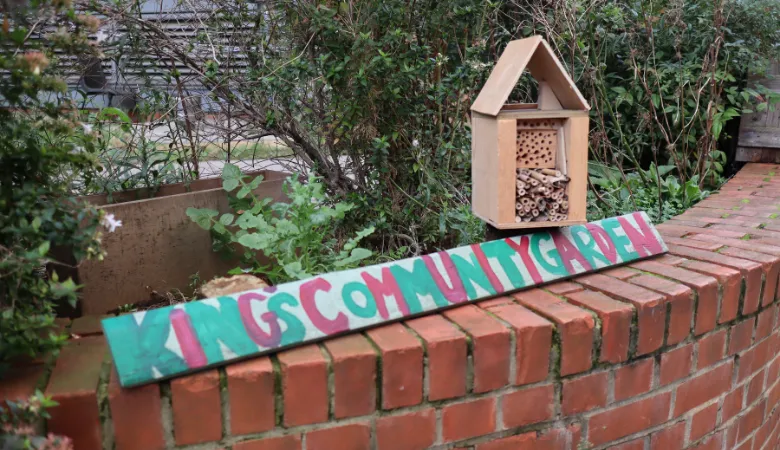
Nimi Dave explains how planting trees can not only boost nature and...

Some of London's must-visit green spaces, including a few close to King’s.

Pedestrianisation in the heart of historic London creates a welcoming...
In May of 2024, Urban Bees installed 24 bee hotels and 6 bee observations boxes across King’s estate, for the purpose of supporting the survival of urban bees. Located on the grounds of residential apartments, at both sportsgrounds and at each of our London campuses, they offer refuge for urban solitary bees throughout the year. A third of bee species are under threat mainly from habitat loss which robs them of nesting sites and food, so installing bee hotel and observation panels are crucial. These bees are excellent pollinators, and they don’t sting. Bee hotels are wooden boxes for cavity-nesting solitary bees, whereas the bee observation boxes are larger wooden nesting boxes with a perspex cover, designed to enable people to see the nesting habits of wild, solitary bees. Urban bees have worked with King’s gardening teams to greatly improve the forage for bees throughout the year. A QR code on the observation boxes and the Urban Bees blog gives more information about the good work being done to support our pollinators.
Read the Urban Bees blogUrban Bees project timeline