
Throughout my career I have been committed to reducing the carbon footprint of communication and computing technologies. This challenge has become all the more urgent with the unprecedented rise of AI and its increasing consumption of energy."
Professor Jaafar Elmirghani
24 September 2025
Professor Jaafar Elmirghani elected Fellow of Royal Academy of Engineering
The fellowship recognises Professor Elmirghani’s contribution to sustainability in communications and computing
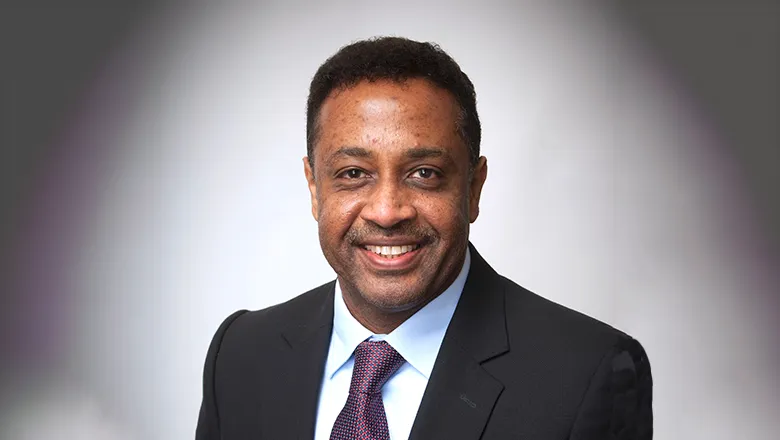
Professor Jaafar Elmirghani from the Department of Engineering has been elected as a Fellow of the Royal Academy of Engineering.
A Professor in Communication Networks and Systems, Professor Elmirghani joins one of 74 new fellows elected on 23 September 2025. Peer-nominated by existing Academy Fellows, he was recognised for his pioneering research on making more sustainable and energy efficient communications and computing technologies.
A recipient of six international awards in this research field, Professor Elmirghani has spent his career reducing the carbon footprint of core communication networks and data centre networks, and cloud and edge processing computing systems - essential infrastructure for running Machine Learning and AI. He has done this by improving energy efficiency through intelligent design, new architectures, and new routing approaches, as well as designing new ways to integrate intermittent, renewable energy sources into communication and computing systems.
His work in this area has also led to improving energy efficiency in industrial practices, with the Institute of Electrical and Electronics Engineers (IEEE) rolling out five new industry standards to improve energy efficiency in communication networks, and cloud and fog computing, based on his work.
He also founded a company, Ultracell Networks Ltd, to commercialise his energy efficient communication and data centre network designs.
Professor Jaafar Elmirghani said, “I am deeply honoured to be elected a Fellow of this country's most prestigious engineering body. This recognition raises the profile of our world leading engineering research and innovation at King’s, while highlighting the crucial importance of sustainability in our field.
"I am very grateful to my many colleagues, mentors, collaborators, students and family who supported me throughout my career and made this achievement possible.
“Throughout my career I have been committed to reducing the carbon footprint of communication and computing technologies. This challenge has become all the more urgent with the unprecedented rise of AI and its increasing consumption of energy. Engineers play a crucial role in developing more energy efficient and greener solutions, and I look forward to working with the Academy on these priorities amongst others.”
Jaafar was a recipient of awards including a Thomas Edison award, the Nokia Bell Labs GreenTouch 1000x award, the UK Institute of Engineering and Technology (IET) Optoelectronics premium award, the US Institute of Electrical and Electronics Engineers (IEEE) Transmission, Access and Optical Systems outstanding technical achievement award, and outstanding service award among others.
This prestigious accolade reflects not only the extent and impact of his personal achievement, but also the leading contribution that King’s and the Department of Engineering makes more widely to the UK engineering profession.
Professor Sir Bashir M. Al-Hashimi, Vice President (Research & Innovation)
Professor Sir Bashir M. Al-Hashimi, Vice President (Research & Innovation) said “I am delighted that Professor Jaafar Elmirghani’s outstanding work in ultralow, energy networking to ensure more sustainable and energy efficient technologies, has been recognised through election to the Fellowship of the Royal Academy of Engineering.
“This prestigious accolade reflects not only the extent and impact of his personal achievement, but also the leading contribution that King’s and the Department of Engineering makes more widely to the UK engineering profession.”
Professor Rachel Bearon, Executive Dean, Faculty of Natural, Mathematical & Engineering Sciences said, “this award recognises the highly important work Jaafar is doing to tackle the critical problem of developing sustainable and low carbon networks, including providing solutions to the ever growing energy demands of AI expansion."
Jaafar joins a growing number of world-leading engineers at King’s who have joined the ranks as Royal Academy of Engineering Fellows, and are contributing to the field in remarkable and inspiring ways"
Professor Rachel Bearon, Executive Dean, Faculty of Natural, Mathematical & Engineering Sciences
“Jaafar joins a growing number of world-leading engineers at King’s who have joined the ranks as Royal Academy of Engineering Fellows, and are contributing to the field in remarkable and inspiring ways, to further King’s mission of making the world a better place through their innovations in engineering.”
Established in 1976, the Royal Academy of Engineering is dedicated to collaborating with more than 1,000 policymakers in both the UK and around the world, with the aim of enhancing the quality of people’s lives. It provides independent guidance to government, drawing on the expertise of a network of over 450,000 engineers.
Every year, the Royal Academy of Engineering a number of Fellows, and International and Honorary Fellows in recognition of their outstanding and continuing contributions to the profession.
Fellows play a vital role at the Academy, overseeing various aspects such as funding UK academic engineering research, and mentoring entrepreneurs via the Academy’s Enterprise Hub. They also have the responsibility for selecting award recipients, which includes the Africa Prize for Engineering Innovation and the MacRobert Award, the UK’s longest-running and most prestigious UK engineering innovation prize.
Sir John Lazar CBE FREng, President of the Royal Academy of Engineering, said:
“Today’s cohort join a community of around 1,700 of some of the most talented engineers and innovators in the UK and around the globe. Their knowledge and experience make them uniquely well placed to tackle the biggest challenges facing the world, and our determination to advance and promote excellence in engineering remains undimmed.”
In this story
Professor in Communication Networks and Systems