

Biography
Daijun Luo is a PhD student in the Department of Physics at King's College London, under the supervision of Dr Emilio Pisanty, as part of the Photonics & Nanotechnology group. His PhD project focuses on Spatiotemporal Light–Matter Interactions in the Extreme Nonlinear Regime.
Prior to joining King's, Daijun obtained his Bachelor's degree in Optical Engineering from the University of Shanghai for Science and Technology (USST), China. He subsequently worked as a research assistant at USST, where his research focused on diffractive optical neural networks and strong-field high-harmonic generation.
His current research investigates the interaction of structured light with matter under extreme nonlinear conditions, with particular interests in ultrafast electron dynamics, attosecond science, and the topological properties of optical fields. He is also interested in the application of machine learning and reinforcement learning to complex optical systems.
Through his research, he aims to develop new theoretical and computational approaches to understanding and controlling light–matter interactions.
Research interests
- Strong-field and ultrafast optics
- Spatiotemporal light–matter interactions and attosecond science
- Structured light and optical topology
- Machine learning
- Reinforcement learning
Thesis title: Spatiotemporal Light–Matter Interactions in the Extreme Nonlinear Regime
Primary supervisor: Emilio Pisanty
Secondary supervisor: Francisco Rodríguez Fortuño
Publications
Research
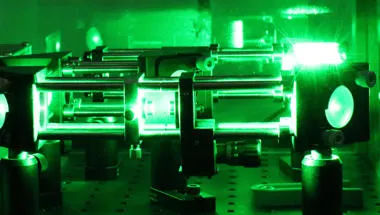
Photonics & Nanotechnology
The research in the group involves the development and applications of advanced photonic technologies and of novel nanomaterials to address modern challenges in photonic and quantum technologies, new nanostructured materials, sensing, imaging and clean energy.
Research
Photonics & Nanotechnology
The research in the group involves the development and applications of advanced photonic technologies and of novel nanomaterials to address modern challenges in photonic and quantum technologies, new nanostructured materials, sensing, imaging and clean energy.