
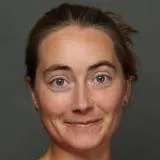
Dr Eleanor Crane
Lecturer (Assistant Professor)
- Policy Fellow, Harvard Kennedy School
- Editor, Quantum Open Access Journal
Research interests
- Natural Sciences
Contact details
Biography
Dr Eleanor Crane is a Lecturer (Assistant Professor) in Quantum Computing in the Department of Physics at King’s College London. She did a postdoc at MIT, where she pioneered the field of quantum computing with native particles: qubit-fermion-boson quantum computing (described in more detail in the Research section below). Her main collaborators are Alexander Schuckert, Steven Girvin, Nathan Wiebe, Isaac Chuang, Michael Gullans and Seth Lloyd. As a board member of the MIT European Club, she organized conferences such as the MIT European Career Fair and the Harvard European Conference, and was a teaching assistant for the MIT leadership course LEAPS, as well as completing the Harvard courses Transforming Systems and Adaptive Leadership. She performed her PhD at UCL, and her university in Paris.
Dr Eleanor Crane is also a Fellow for Quantum Policy at the Belfer Center for Science and International Affairs, Harvard Kennedy School where she researches and teaches quantum policy for Defense, Emerging Technology, and Strategy with Eric Rosenbach. The Economist just wrote a great article about her Critical and Emerging Technologies Index. With MIT and Accenture, she took quantum algorithms and quantum companies hardware roadmaps to build this advantage prediction tool: Quantum Economic Advantage Calculator.
Research
The aim of her research is to theoretically lay the foundations of a novel type of quantum computer. This computer is geared towards the understanding of quantum processes in nature which cannot be simulated with classical computers such as helping the development of fusion reactors, understanding photosynthesis, finding more efficient fertilizers, building batteries with longer lifetimes etc. So far, quantum computers have qubits as their computational elements. However, nature is made up of two fundamental particle types: fermions (into which we classify electrons, leptons etc), and bosons (into which we classify photons, phonons etc). The novel computer which I am developing with my theorist and experimentalist colleagues is one which has qubits but also fermions and bosons as additional computational elements (see her Qiskit Seminar Series). To simulate an electron in an atom of the leaf of a tree absorbing a photon of light from the sun, causing a vibration of the atomic lattice called a phonon, one would no longer need to map it all out to qubits, but could directly map this to fermions and bosons interacting via quantum gates in our novel quantum computer. One of the things she has been focussing on in her work is showing how this will be a very efficient tool to speed up simulations of nature. Beyond showing the promise of these novel quantum computers, we work on the full stack, from the device physics and instruction set architectures, to compilation, transpilation, error correction, algorithms and measurements and novel physics and applications as well as collaborating with experiments on running proof of principle demonstrations. This has gotten her and her team into the Google XPRIZE semifinals.
Publications
- Hybrid Oscillator-Qubit Quantum Processors: Simulating Fermions, Bosons, and Gauge Fields
- Fault-tolerant fermionic quantum computing
- Hybrid Oscillator-Qubit Quantum Processors: Instruction Set Architectures, Abstract Machine Models, and Applications
- Symbolic Hamiltonian Compiler for HybridQubit-Boson Processors
Additional Information
News
Norwegian Minister for Research and Higher Education visits King's to discuss the future of quantum innovation
The Norwegian Minister for Research and Higher Education visited King's College London this week to take part in a roundtable discussion exploring emerging...

King's partners with Google Quantum AI and National Quantum Computing Centre to explore quantum fundamentals
Prestigious joint initiative will hope to lay strong foundations for creating better materials, energy systems and medical treatments.

News
Norwegian Minister for Research and Higher Education visits King's to discuss the future of quantum innovation
The Norwegian Minister for Research and Higher Education visited King's College London this week to take part in a roundtable discussion exploring emerging...
King's partners with Google Quantum AI and National Quantum Computing Centre to explore quantum fundamentals
Prestigious joint initiative will hope to lay strong foundations for creating better materials, energy systems and medical treatments.