

Professor Frank Hirth PhD, Dr. habil, Dipl. rer. nat.
Professor of Evolutionary Neuroscience
Research interests
- Neuroscience
Contact details
Biography
Frank Hirth is Professor of Evolutionary Neuroscience at the Institute of Psychiatry, Psychology & Neuroscience at King's College London.
Frank investigates how neural circuits form and function, especially central brain circuits in the vertebrate basal ganglia and insect central complex that coordinate voluntary behaviour.
In an evolutionary approach, he applies insights to understand how cell and circuit dysfunction can cause Parkinson's and Motor Neurone Disease, as well as Frontotemporal Dementia. He previously discovered evolutionarily conserved genetic mechanisms underlying insect and mammalian brain development.
Frank's work led to the identification of molecular and cellular mechanisms underlying TDP-43 and C9orf72-related disease formation in MND and FTD.
Frank actively participate in undergraduate and graduate neuroscience teaching and co-organised the flagship module at King's in “Cell and Systems Neuroscience”.
Frank is a board member of the Alzheimer's Research UK at King's College London Network and is regularly engaged in knowledge dissemination about brain evolution.
Find out more about my research
Key collaborators
- Professor Nicholas J. Strausfeld, University of Tucson
- Dr James Hodge, University of Bristol
- Professor Christopher Shaw, King's College London
- Professor Dag Aarsland, King's College London
Key publications
- Strausfeld, Hou, Sayre & Hirth 2022. The lower Cambrian lobopodian Cardiodictyon resolves the origin of euarthropod brains. Science
- Bridi et al., 2020. Ancestral regulatory mechanisms specify conserved midbrain circuitry in arthropods and vertebrates. Proc. Natl. Acad. Sci. USA
- Kottler et al., 2019. Inverse Control of Turning Behavior by Dopamine D1 Receptor Signaling in Columnar and Ring Neurons of the Central Complex in Drosophila. Current Biology.
- Solomon et al., 2018. A feedback loop between dipeptide-repeat protein, TDP-43 and karyopherin-α mediates C9orf72-related neurodegeneration. Brain.
- Strausfeld & Hirth 2013. Deep Homology of Arthropod Central Complex and Vertebrate Basal Ganglia. Science.
News
New mechanism found for neuronal death in Alzheimer's and frontotemporal dementia
Markers of a new mechanism for cell death, called karyoptosis, have been found in brains of patients with Alzheimer’s disease and frontotemporal dementia...

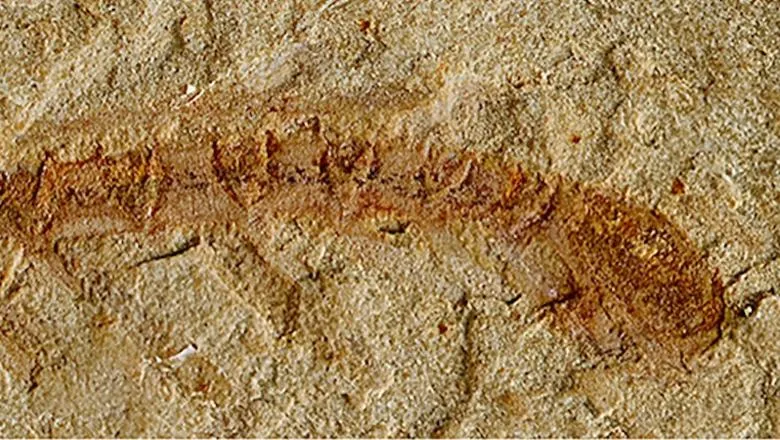
525-million-year-old fossil defies textbook explanation for brain evolution
New research from the Institute of Psychiatry, Psychology & Neuroscience (IoPPN) at King’s College London, in partnership with the University of Arizona...
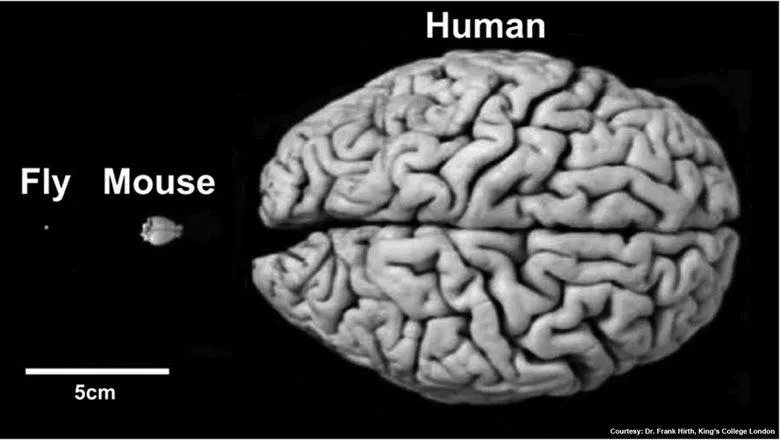
Humans and flies employ very similar mechanisms for brain development and function
A new study led by researchers from King’s College London has shown that humans, mice and flies share the same fundamental genetic mechanisms that regulate...
Features
A year in Alzheimer's Research at King's
Alzheimer’s disease is the most common form of dementia, affecting 1 in 14 people over the age of 65 in the UK, yet there is currently no cure. To mark World...

News
New mechanism found for neuronal death in Alzheimer's and frontotemporal dementia
Markers of a new mechanism for cell death, called karyoptosis, have been found in brains of patients with Alzheimer’s disease and frontotemporal dementia...
525-million-year-old fossil defies textbook explanation for brain evolution
New research from the Institute of Psychiatry, Psychology & Neuroscience (IoPPN) at King’s College London, in partnership with the University of Arizona...
Humans and flies employ very similar mechanisms for brain development and function
A new study led by researchers from King’s College London has shown that humans, mice and flies share the same fundamental genetic mechanisms that regulate...
Features
A year in Alzheimer's Research at King's
Alzheimer’s disease is the most common form of dementia, affecting 1 in 14 people over the age of 65 in the UK, yet there is currently no cure. To mark World...