
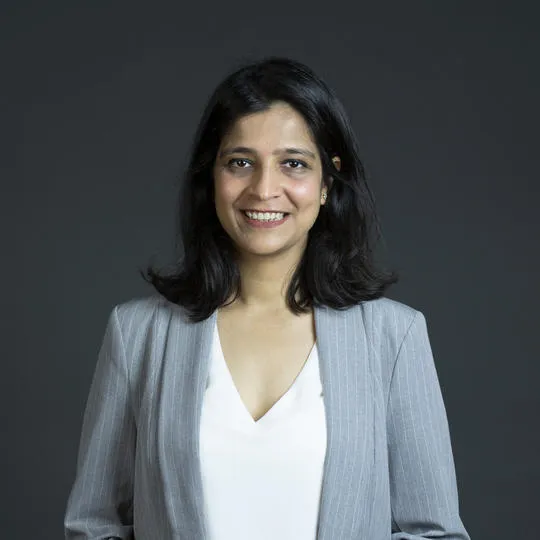
Dr Udisha Saklani
Lecturer in Human Geography & Climate
Biography
Udisha Saklani is a Lecturer in Human Geography and Climate in the Department of Geography at King's College London. Her research examines the political economy of infrastructure and climate transitions, with a particular interest in how their costs and benefits are distributed and governed. Her work is primarily based in South Asia, with a particular focus on energy, water and large-scale infrastructure.
Udisha completed her PhD in Geography at the University of Cambridge in 2023, where she examined the politics and governance of large-scale hydropower development in the Himalayas. Alongside her academic research, she has worked with governments and international organisations, including UNDP, Oxfam Novib and Australia's Department of Foreign Affairs and Trade (DFAT), on climate, water and infrastructure programmes across the Indo-Pacific.
Before joining King's College London, she was a Lecturer in Human Geography at Monash University. She holds a Master in Public Policy from the National University of Singapore and a BA (Hons) in Mathematics from St. Stephen's College, University of Delhi.
Research
- Political economy and governance of infrastructure
- Climate and energy transitions
- Distribution, justice and public legitimacy
- Water and energy governance
- Infrastructure finance and state-market-society relations
Udisha’s research examines how infrastructure, finance, and state institutions shape climate and development pathways in the Global South. Her work focuses on water and energy systems, drawing on extensive fieldwork in South Asia and policy engagement across the Indo-Pacific. Adopting a political economy approach, she analyses how large-scale infrastructure projects are governed, financed, and contested, and how they produce uneven social and environmental outcomes. Across her work, she is particularly interested in questions of distribution, legitimacy, and institutional power in climate transitions, with empirical focus on hydropower and water governance. Building on this, she is developing a new strand of research on digital governance and AI in urban infrastructure systems, examining how data-driven technologies are reshaping decision-making, accountability, and state–citizen relations in cities across the Global South.
Teaching
Undergraduate
- 4SSG1008 Geography Tutorials: Critical Thinking & Techniques
- 4SSG1016 Geography in Action
- 5SSG2047 Field Research in Human Geography – Field trip to Lisbon
- 5SSG1011 Principles of Geographical Inquiry
Postgraduate
- 7QQMM900 The Challenges of Climate Change
- 7SSGN176 Fundamentals of Climate Change
- 7SSGN227 Researching Climate Change: Key Methods
- 7SSGN119 Fundamentals of Risk, Disasters and Resilience
Further details
Research

Geopolitics and Contested Development research group
Exploring geopolitics and contested development as locally contingent and globally interconnected processes shaped by the politics of colonialism.

Urban Futures research group
Contributing to a more sustainable and just future by studying some of the most pressing issues and challenges facing cities today.

King's Water Centre
Researching water, environment and development. Our centre spans the humanities, social, and physical sciences to explore the challenges of water governance from global to local scales.

King's Climate Research Hub
Studying climate change through the relationship between science, policy and culture.

Just Transitions and Interdisciplinary Peace research group
Research group examining the transitions, natural resource governance, and (in)security impacted by decarbonisation and sustainability initiatives.
News
COMMENT: Plaid Cymru plans to share wind farm profits with local people – here's how that idea has been tried elsewhere
When wind turbines rise above a Welsh hillside, who should benefit financially? Plaid Cymru’s Rhun ap Iorwerth believes it should be local communities.

COMMENT: Dams for development? Unpacking tensions in the World Bank's hydropower policies
The World Bank’s hydropower policies reveal ongoing tensions as new sustainability and equity goals are layered onto older development practices, leaving...

Research
Geopolitics and Contested Development research group
Exploring geopolitics and contested development as locally contingent and globally interconnected processes shaped by the politics of colonialism.
Urban Futures research group
Contributing to a more sustainable and just future by studying some of the most pressing issues and challenges facing cities today.
King's Water Centre
Researching water, environment and development. Our centre spans the humanities, social, and physical sciences to explore the challenges of water governance from global to local scales.
King's Climate Research Hub
Studying climate change through the relationship between science, policy and culture.
Just Transitions and Interdisciplinary Peace research group
Research group examining the transitions, natural resource governance, and (in)security impacted by decarbonisation and sustainability initiatives.
News
COMMENT: Plaid Cymru plans to share wind farm profits with local people – here's how that idea has been tried elsewhere
When wind turbines rise above a Welsh hillside, who should benefit financially? Plaid Cymru’s Rhun ap Iorwerth believes it should be local communities.
COMMENT: Dams for development? Unpacking tensions in the World Bank's hydropower policies
The World Bank’s hydropower policies reveal ongoing tensions as new sustainability and equity goals are layered onto older development practices, leaving...