'Greater diversity, deeper professionalism… and collaboration': Dame Tamara Finkelstein reflects on the future of the Civil Service
Dame Tamara Finkelstein DCB shared valuable insights from extensive experience in Civil Service leadership
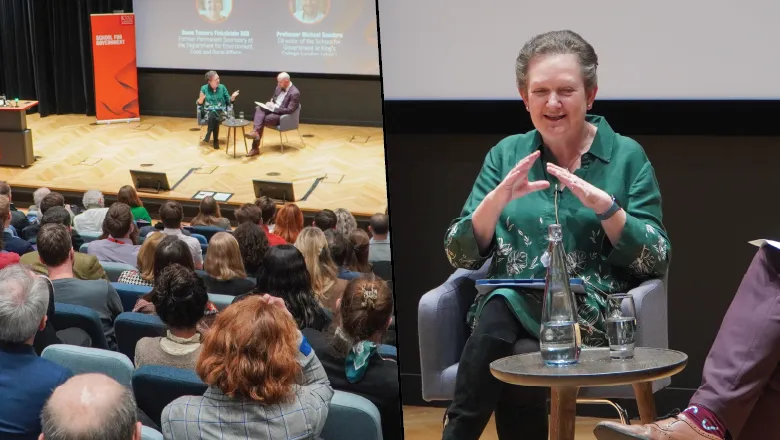
The School for Government hosted Dame Tamara Finkelstein DCB, one of the UK’s most experienced former civil servants, on 3 December for a discussion on her career and the future of the Civil Service.
Marking the relaunch of the School under the leadership of Professor Michael Sanders, Dame Tamara reflected on her 33 years in the Civil Service, a period that encompassed some of the most contentious and volatile moments in the UK’s recent political history.
As Director General and later Permanent Secretary at the Department of Energy, Food and Rural Affairs, she oversaw a time of profound instability and change within the department – from implementing legislation and trade agreements to building new IT systems, something she noted had been challenging for the Civil Service at the time.
“Change is hard. [Brexit] was a politically contentious issue. But our role as civil servants is to implement.”
Dame Tamara Finkelstein DCB
These challenges were compounded by significant turnover at the senior leadership level. During Dame Tamara’s six years as Permanent Secretary, the department saw seven different Secretaries of State – a level of disruption she said had implications for staff, external stakeholders and delivery.
“Each Secretary of State had a different view... that meant you had to go back to the drawing board to influence that policy and that definitely impacted delivery.”
Dame Tamara Finkelstein DCB
Change, she said, was occurring almost daily. One of her greatest challenges was supporting leaders and civil servants through this turbulence so they could perform at their best, providing daily meetings to explain what was happening, the next steps, and inviting civil servants to share their concerns.
This period of instability also fed into a wider national debate on the impartiality of the Civil Service, with some political parties suggesting the appointment of more political appointees to senior leadership roles. While Dame Tamara acknowledged the concerns of incoming ministers following electoral change, she argued that an impartial Civil Service remains valuable.
“It is clear if you’ve got civil servants, you are not a politician and the expectation is that you know your stuff and help [officials] to deliver on their agenda. If you have a political layer, you inevitably have people who do have much stronger views [and] I think that’s a greater clouding of who is leading the department and who is shaping the direction of travel.”
Dame Tamara Finkelstein DCB
However, Dame Tamara stressed that reforms are still needed if advocates for Civil Service impartiality are to win the argument. Improvements in professionalism, subject-matter knowledge and organisational efficiency are essential, she said.
As the Civil Service marks its 155th anniversary, Dame Tamara concluded by reflecting on the changes she hopes to see. While recognising how far the institution has evolved since she joined in 1992, she expressed a desire for greater diversity, particularly at leadership level, and for deeper professionalism.
Digital transformation is also crucial, she argued, with AI and improved interaction between civil servants and technology offering opportunities for greater efficiency.
“What I would love to see is the Civil Service at the forefront of [technology] and to be an anchor procurer of some of the really innovative approaches.”
Dame Tamara Finkelstein DCB
She also highlighted the need for stronger collaboration – moving away from siloed working towards more outcomes-based, multidisciplinary and system-wide approaches, underpinned by supportive leadership.
Dame Tamara was joined at the event by Professor Rachel Mills CBE, Senior Vice President (Academic) at King’s, and Professor Jennifer Rubin, Chair of the Advisory Board of the School for Government. They paid tribute to Michael and to the School’s achievements since his appointment, supported by the Faculty of Social Science & Public Policy and the Policy Institute. These include a growing partnership with the Civil Service, bespoke programmes with the Department of Health and Social Care and the Foreign, Commonwealth and Development Office, and an impressive cohort of visiting faculty such as Baroness Camilla Cavendish and Lord Peter Hain.