
The Dravidian Pathway: The Dravida Munnetra Kazhagam (DMK) and the Politics of Transition in South India
Dr Vignesh Rajahmani, former King's India Institute scholar, will speak about his book.
01 December 2025
Dr Vignesh Rajahmani returned to King’s India Institute to launch his book The Dravidian Pathway, offering fresh insights into how South India’s Dravidian movement transformed from a radical social cause into a lasting force in democratic politics.
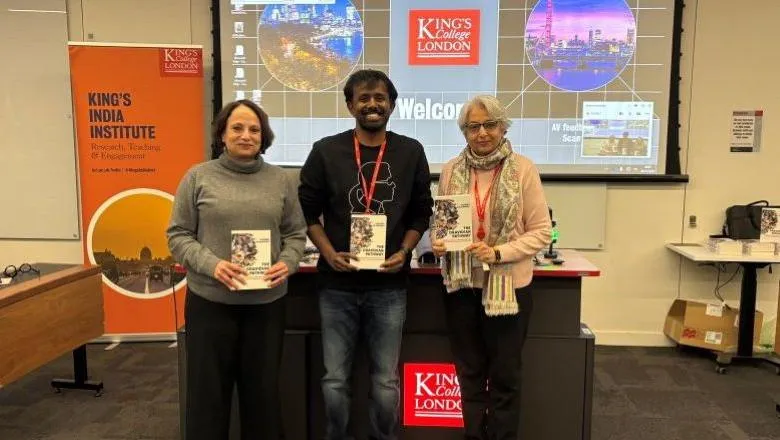
Returning to the King’s India Institute, where his academic journey began, Dr Vignesh Rajahmani presented his new book The Dravidian Pathway: The Dravida Munnetra Kazhagam (DMK) and the Politics of Transition in South India at an event on 26 November hosted by the School of Global Affairs and the King’s India Institute.
The book emerged from his doctoral thesis, which was jointly supervised by Professor Christophe Jaffrelot and Dr Kriti Kapila and has now culminated in a major scholarly contribution to the study of contemporary South Indian politics.
The discussion, chaired by Dr Kriti Kapila with Professor Niraja Gopal Jayal as discussant, explored how a radical social movement in South India evolved into a durable force in democratic politics.
Dr Rajahmani, an alumnus of King’s MA in Modern India (2012-13) and PhD in Political Science and Public Policy (2019-23), described the evening as a homecoming, reflecting on a decade of research that began with his first conversation with Dr Kapila in 2012.
At the heart of the book lies a central question: how does a sociocultural movement, organised around self-respect and anti-caste equality, become an electorally viable party?
Dr Rajahmani situates the Dravidian movement within global examples of social movements entering party politics, while highlighting its distinctive trajectory from the Justice Party governments of the 1920s to the DMK’s victory in 1967.
A major empirical contribution is his account of Tamil Nadu’s reading rooms - modest spaces that functioned as “civic classrooms” for democratic debate. These rooms, often doubling as tea shops or cycle repair stalls, hosted collective reading and discussion in Tamil, challenging cultural hierarchies and fostering political literacy.
Professor Jayal praised this level of detail but asked Vignesh to elaborate the links between literacy policy and civic spaces. This opened a discussion on K. Kamaraj’s educational reforms and the mid day meal scheme, programmes backed and operationalised by supporters of the Self Respect Movement and the Dravidar Kazhagam.
The conversation also turned to gender and caste representation. Despite progressive legislation and pioneering policies on transgender rights, women’s representation in Tamil Nadu’s assembly remains low.
Vignesh attributes this pattern to symbolic choices within Dravidian politics, which are now being addressed incrementally at the party organisation level as a follow up to the India wide local government reforms of the 1990s. On caste, his dataset shows near proportional representation overall, leading one of the most diverse legislative assemblies in the country.
Closing the event, Dr Kapila situated the book within the Institute’s research agenda on democracy and welfare, while Professor Jayal commended its scholarly depth. For Dr Rajahmani, now an early career scholar, the launch marked another milestone in a long intellectual journey with King’s - one that continues to raise vital questions about recognition, redistribution and the future of civic education in India.
Research Affiliate
Avantha Chair
Senior Lecturer in Social Anthropology and Law

Professor of Indian Politics and Sociology
Dr Vignesh Rajahmani, former King's India Institute scholar, will speak about his book.