We live in an era of rapidly shifting global relations. The UK Government has responded by pledging – to quote Deputy Prime Minister David Lammy – to “re-imagine Britain’s role on the world stage, reinvigorate alliances and forge new partnerships”. A rethinking of cultural heritage restitution is crucial to that reimagining. Our ten global partners will help us set an agenda for an equitable redistribution of archive and heritage resources, and the artists we work with will help us understand how restored archival materials can function as resources for refigured cultural futures.
Professor Erica Carter, Professor of German and Film
03 December 2025
New project sets African-led agendas for film heritage restitution
A new £1.1 million project funded by the Arts and Humanities Research Council will engage an international team of scholars, archivists and filmmakers in research on African film heritage restitution.
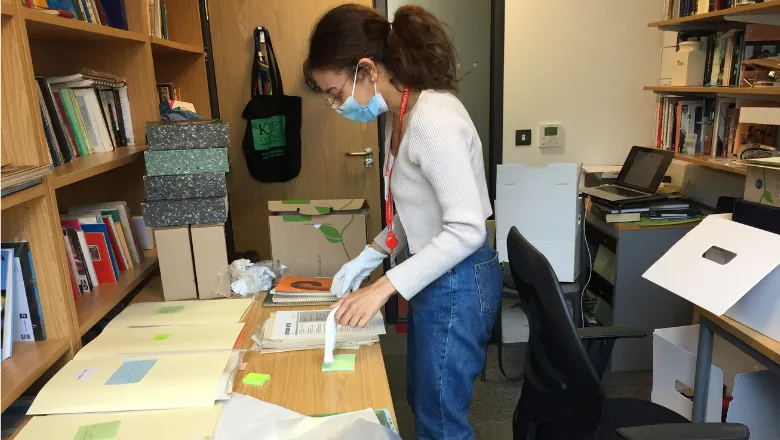
In January 2026, work begins at King’s on a project that sets new agendas for restitution of African film heritage. Unhousing Restitution: African Film Heritage between Displacement and Return (UNREST) is a two-year interdisciplinary project addressing urgent issues of African cultural heritage and reparatory justice.
From the Benin Bronzes to Ghana’s Asante Kingdom gold, demands are accelerating from former colonised nations for return of objects looted or extorted during British colonial conquest and rule. Less often highlighted are restitution claims for films and related artefacts: European archives are replete with film collections documenting twentieth-century colonial rule. Precious collections from postcolonial cineastes – African examples include Ousmane Sembene, Med Hondo, Paulin Vieyra – are housed in Global North archives, with access for African audiences limited by constraints of geography, copyright, technology, scarce resources and more.
In response to these dilemmas, UNREST was incubated by Professor Erica Carter, Professor of German and Film in the Department of Film Studies, during her Global Cultures Institute Fellowship in 2024. It will be led by Professor Carter with co-investigators Dr Dan Hodgkinson from the University of Oxford, Dr Samar Abdelrahman from the University of Liverpool, and ten international partners from Sudan, Egypt, Ghana, Germany and the UK.
The Global Cultures Institute is delighted to have been able to support Professor Carter with a Research Fellowship to enable her to work on this grant application. UNREST represents the importance of arts and humanities research for understanding many of the world's most complex, intractable and alarming political situations.
Professor Daniel Orrells, Chair-Director, Global Cultures Institute
In 2021, UNESCO concluded that African cinema’s ‘best surviving elements’ are almost never found in Africa’. Yet the British Film Institute records only one successful instance of colonial film restitution (to Trinidad and Tobago).
The lack of available models presents urgent challenges. Flexible restitution modes are needed that meet ethical demands for reparatory justice, while overcoming obstacles including budgetary constraints, infrastructure deficits, inflexible legal frameworks, political instability or military conflict.
UNREST responds with a collaborative project that combines historical enquiry, digital archive development and creative research on two African case studies: Sudan and Ghana. Central to the project is a shift from restitution agendas set by Global North nation states to collaborative research driven by the needs and demands of African archivists, filmmakers, researchers, critics and audiences.
The background
Since 2020, Professor Carter has worked with partners in Sudan, Egypt and Germany, alongside UK-based colleagues including Dr Abdelrahman and the psychotherapist and writer Dr Eiman Hussein, to retrieve and recirculate the archive of Dr Hussein’s father, the exiled Sudanese artist-filmmaker Hussein Shariffe.
Shariffe belonged to a generation of cineastes who shaped Sudan’s distinctively experimental and anti-colonial 1970s and ‘80s film culture. This generation was driven into exile and their films banned during thirty years of dictatorship under Omar al-Bashir. Shariffe himself took refuge in Cairo; when he died in 2005, his films and documents were widely scattered. They found eventual sanctuary in Berlin and London, but remain inaccessible to the Sudanese audiences whose histories and memories they record.
I’m thrilled to be part of UNREST. The project addresses the urgent and long-overdue work of rethinking restitution and film heritage. It challenges conventional models of return, advocating for innovative forms of access, engagement, and collaboration that respond to present crises while opening new possibilities for African cinema’s creative future and intergenerational dialogue.
Dr Samar Abdelrahman, University of Liverpool
King’s work on the archive of Shariffe is mirrored in recent research by UNREST co-investigator Dr Hodgkinson. His Leverhulme-funded Visions of Life project explores the past futures imagined by Anglophone Africa’s first postcolonial film industry: the Ghana Film Industry Corporation (GFIC), set up in the 1960s by Kwame Nkrumah, the first leader of independent Ghana.
After Nkrumah’s removal from office in a coup in 1966, his filmmakers were sacked, and his films destroyed or left to rot. The few remaining GFIC copies languished for years in a London vault. Efforts to return them to Ghana repeatedly faltered; digitisation of a small selection – the Hesse Collection – was recently completed in collaboration with Ghanaian partners by LA-based film director Ben Proudfoot, but plans remain as yet unrealised for the digital copies’ return.
There's a lot of talk these days about redress, decolonisation, and restitution, relating to all sorts of historical artefacts and issues. But there’s much less clarity on what actually needs to be done. UNREST tackles these issues head on - and all of us in the project, from Tamale to Cairo, can’t wait to get started.
Dr Dan Hodgkinson, University of Oxford: UNREST Co-Investigator
During UNREST, the Hesse and Shariffe collections will be redesigned as two portable digital archives of Sudanese and Ghanaian audiovisual heritage. The archives will travel to sites of encounter with young African creatives in Egypt and Ghana. Artists from Ghanaian and refugee Sudanese creative communities will work with artistic directors Talal Afifi (Sudan Film Factory), Tamer el Said (Cimatheque Cairo) and Ibrahim Mahama (Savannah Arts Centre, Tamale, Ghana) to complete the restitutionary process in year-long artistic projects that re-embed cinematic heritage within contemporary audiovisual imaginaries.
Culminating in public events at the British Film Institute, Cimatheque Cairo, Arsenal Berlin and Ghana Academy of Film and Television Arts, the project will move restitution debates from a focus on the politics of return, to practices of shared transnational history-making, collaborative infrastructure development and African-led creative renewal.
About the Global Cultures Institute
Even in a globalised world, we come into daily contact with limits and boundaries, which divide us in stark and sometimes harmful ways on the grounds of language, culture, community, and identity.
At the Global Cultures Institute, by fostering conversations that are profoundly interdisciplinary, we probe and articulate these boundaries, developing a critical understanding of their origins and development, and sharing this understanding through research, education and public engagement.
Shaping a space at King’s for debate that is generous and robust, we confront the challenge of intensifying divisions and seek ways to talk beyond boundaries.
In this story

Professor of German and Film

University of Oxford

University of Liverpool