

Biography
Nicola is a Machine Learning/AI Engineer and Research Affiliate at the King's Institute for Artificial Intelligence, specialising in full-stack, multimodal AI systems and hybrid computing architectures. Currently pursuing a PhD focused on classical-to-quantum machine learning skill transition, her research investigates the technical and operational constraints that shape hybrid classical–quantum workflows in real-world systems. In 2026, she presented an enterprise quantum adoption framework at IBM’s Innovation Studio in London and delivered a live hybrid QML pipeline demonstration on IBM quantum hardware supported by a King's Public Engagement Grant.
During her time at the Institute, Nicola has designed and delivered bespoke advanced AI modules for the international King’s–Bolashak Scholars Programme, training interdisciplinary cohorts across medicine, forensics, and technical sciences. Her current engineering work spans computer vision, vision-language models, and combinatorial optimisation, building on research interests established during her MSc in Computer Science and supported by subsequent professional training in advanced AI applications at the University of Oxford.
Beyond her core research, Nicola develops applied machine learning prototypes for space-sector outreach, spanning flight dynamics, predictive trajectory forecasting, and real-time hazard tracking. Building on her annual contributions architecting simulation workflows for the UKSEDS National Student Space Conference, she authored the 2025 technical series ‘AI Software Tool Creation: Leveraging NASA MERRA-2 Data’. Created in collaboration with NASA data specialists, environmental forecasting and physics-based aerospace prototypes engineered for the series were subsequently presented at NASA GES DISC Future of Giovanni and the NASA LaRC POWER GloCo Summit.
Driven by a commitment to championing young women in technical fields, Nicola also spearheaded a nationally deployed space technology curriculum framework for the Girls’ Day School Trust (GDST), leveraging support from the Royal Society STEM Partnership and the AWS Proof of Concept Programme. Building on this foundation, she partnered with Edge Impulse Inc. and Cranfield University’s CranSEDS engineering team to co-author the BCS-accredited Tech10 AI for Edge Computing digital badge, delivered at the National Space Centre.
Research interests
- Hybrid Quantum Engineering Capability Frameworks
- Hybrid Classical–Quantum Workload Benchmarking
- Hardware-Aware Variational Quantum Circuit Design
- Full-Stack Multimodal AI & Production Orchestration
- Edge AI Computing & Hardware-Constrained Deployments
- Technical Capability Building & Interdisciplinary AI Training
Thesis
Optimising Skill Transition Pathways from Classical to Quantum Machine Learning
As quantum machine learning (QML) evolves from theoretical research towards practical engineering applications, a significant barrier has emerged: enabling experienced classical machine learning practitioners to transition effectively into hybrid quantum computing environments. This research investigates the technical and cognitive processes underlying that transition, with the objective of accelerating workforce capability for quantum-enabled engineering.
The study employs Design-Based Research (DBR) as an iterative experimental methodology, using instrumented software sandboxes to evaluate how practitioners interact with progressively more complex hybrid quantum workflows. Classical machine learning practices, including data preprocessing, feature engineering, optimisation strategies, and neural network design, are systematically mapped to equivalent quantum implementations involving feature-map encoding, parameterised quantum circuits, shallow circuit constraints, and hardware-aware optimisation. Participant interactions are analysed through behavioural telemetry, software execution traces, performance metrics, and structured technical dialogue to identify points of cognitive friction, negative transfer, and implementation bottlenecks. These findings are iteratively incorporated into the design of the software environments to improve technical capability acquisition and reduce transition overhead. The project aims to produce an evidence-based engineering framework that supports organisations in preparing machine learning practitioners for hybrid classical-quantum development.
Principal supervisor: Mary Webb
Secondary supervisor: Peter Kemp
Research
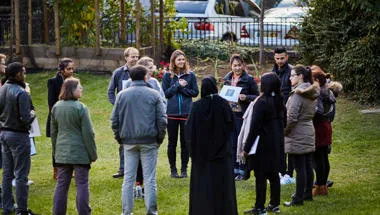
Centre for Research in Education in Science, Technology, Engineering & Mathematics (CRESTEM)
Centre for Research in Education in Science, Technology, Engineering & Mathematics (CRESTEM)
Research
Centre for Research in Education in Science, Technology, Engineering & Mathematics (CRESTEM)
Centre for Research in Education in Science, Technology, Engineering & Mathematics (CRESTEM)