

Dr Paola Di Meglio
Senior Lecturer in Cutaneous Immunology
Research interests
- Immunology
Biography
Dr Di Meglio received her PhD in Pharmacology from the University of Naples Federico II (Italy) and trained at Yale University (USA), St. John’s Institute of Dermatology (London), and at the MRC NIMR, now the Francis Crick Institute (London). In March 2017 she became Lecturer in Cutaneous Immunology at St John’s Institute of Dermatology and was promoted to Senior Lecturer in 2022.
Dr Di Meglio’s research interest is in the etiopathogenesis of complex inflammatory skin conditions, with a particular focus on the mechanistic interplay between genetic, environmental and immune factors. She has also an interest in pharmacogenomics and biomarkers discovery.
Dr Di Meglio has been the recipient of the European Society for Dermatological Research (EASDR)/Celgene Award, and of the British Society for Investigative Dermatology (BSID) Young Investigator Award, both in 2014. She has given over 40 invited lectures, including at the World Congress of Dermatology in 2015, the Montagna Symposium on the Biology of Skin in 2017 and at the European Society of Dermatological Research (ESDR) Annual meeting in 2022.
She is Section Editor in Dermatology and Skin Immunology for Pharmacological Research and Associate Editor for The Journal of Investigative Dermatology. She is the Chair of the British Society of Investigative Dermatology (BSID).
Research
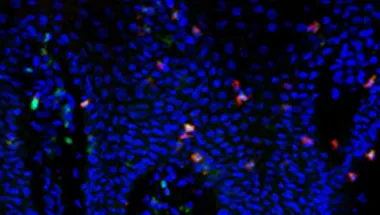
The Cutaneous Immunology Group
The Cutaneous Immunology Group are based in St John's Institute of Dermatology
News
Outcomes of psoriasis treatment can be predicted by white blood cell response to test, scientists discover
The way type 2 conventional dendritic cells (cDC2) respond to an in vitro test before the patient commences therapy can predict whether the therapy is going...
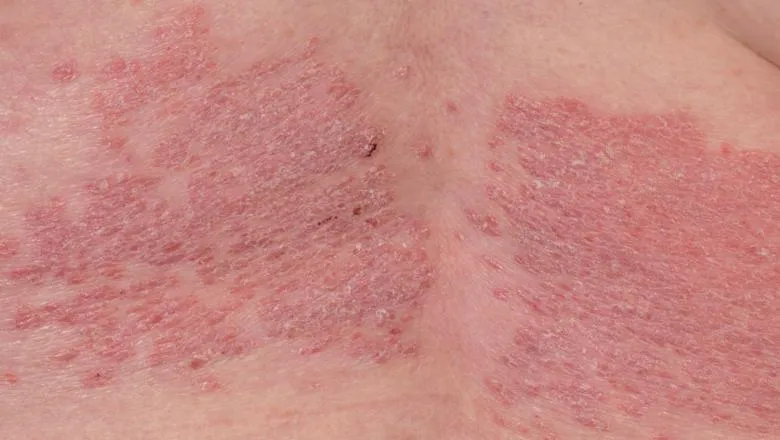
Enzyme found to treat inflammatory skin conditions
Researchers have found an enzyme that plays a role in inflammatory skin diseases and could be a good target for new treatments for conditions like psoriasis.

Study identifies cells involved in the development of eczema and psoriasis
Researchers from St John’s Institute of Dermatology analysed cells in the blood from people with two skin diseases; psoriasis and atopic dermatitis (AD), also...

Assessment Sub-Board Chair for Immunology and Microbial Science
Module Lead:
- 6BBYI313 Infection Disease and Immunobiology Laboratory Project (iBSc)
- 6BBI0101 Immunomodulation and Translational Research
Course teacher:
- EMDPCSM1A1B Core Skills and Medicine
- 4MBBS103 Gene, Behaviour and Environment
- 6BBBI308 Immunology of Human Disease
- 6BBI0101 Immunomodulation and Translational Research
- 7MJDER01 Theoretical Dermatology
- 7MCEMM03 Immune Disorders and Infection
Research
The Cutaneous Immunology Group
The Cutaneous Immunology Group are based in St John's Institute of Dermatology
News
Outcomes of psoriasis treatment can be predicted by white blood cell response to test, scientists discover
The way type 2 conventional dendritic cells (cDC2) respond to an in vitro test before the patient commences therapy can predict whether the therapy is going...
Enzyme found to treat inflammatory skin conditions
Researchers have found an enzyme that plays a role in inflammatory skin diseases and could be a good target for new treatments for conditions like psoriasis.
Study identifies cells involved in the development of eczema and psoriasis
Researchers from St John’s Institute of Dermatology analysed cells in the blood from people with two skin diseases; psoriasis and atopic dermatitis (AD), also...
Assessment Sub-Board Chair for Immunology and Microbial Science
Module Lead:
- 6BBYI313 Infection Disease and Immunobiology Laboratory Project (iBSc)
- 6BBI0101 Immunomodulation and Translational Research
Course teacher:
- EMDPCSM1A1B Core Skills and Medicine
- 4MBBS103 Gene, Behaviour and Environment
- 6BBBI308 Immunology of Human Disease
- 6BBI0101 Immunomodulation and Translational Research
- 7MJDER01 Theoretical Dermatology
- 7MCEMM03 Immune Disorders and Infection