
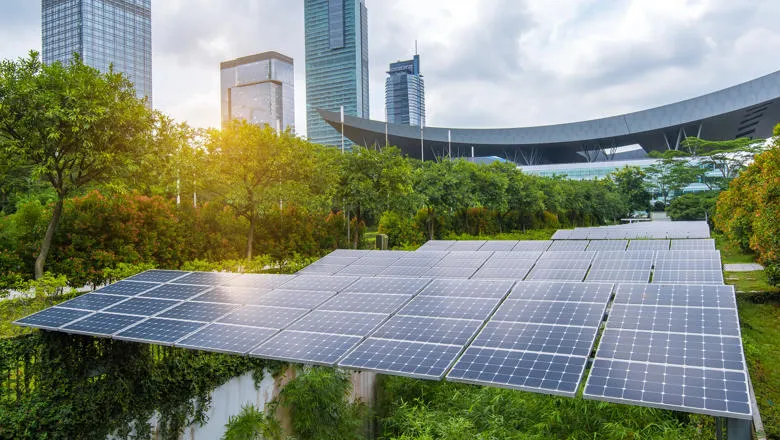
AI for sustainability: opportunities and challenges
Can AI help fight climate change? We capture the discussion of a panel of...
Artificial intelligence (AI) is expanding rapidly, with significant implications for both people and the planet.
This comes with both opportunities and complexities. AI has enormous potential to accelerate climate research, optimise energy systems and support solutions to environmental issues. However, there are widespread concerns over its energy and environmental impacts, with AI both resource- and energy-intensive, driving emissions and producing e-waste. Ethical, regulatory and societal considerations add further layers of responsibility and complexity.
Here at King's, we are committed to ensuring AI serves society’s needs while upholding the highest ethical standards. By centring ethics and sustainability at the heart of our approach to AI, we are combining innovation with responsibility to transform how we address global challenges – from healthcare and justice to climate and security.
The King’s Institute for Artificial Intelligence (KIAS) is one of the key ways we are investing in research and education that embeds fairness, transparency and sustainability within AI. Through projects such as KIAS, King’s is working to develop innovative approaches to better understand and address the environmental impacts of AI.
King’s Institute for Artificial IntelligenceCo-designing Encounters with AI in Education for Sustainable DevelopmentDesigning an AI-Driven Curriculum for Employable Business Students: Authentic Assessment and Generative AIResponsible AI UK
Can AI help fight climate change? We capture the discussion of a panel of...

A new research project led by Dr Gabrielle Samuel, Lecturer in...

Machine Learning Engineers’ own perceptions of their environmental impact...
King’s College London researchers are pushing boundaries in sustainable AI, including research from the Faculty of Natural, Mathematical & Engineering Sciences, whose computer scientists are working to solve the AI - environmental cost issue. Dr Frederik Mallmann-Trenn is exploring how to make neural networks, including those behind ChatGPT and other Large Language Models, leaner and more energy efficient. Dr Georgia Panagiotidou and team are building tools to raise awareness of the environmental cost of AI. This includes a browser extension that shows users, in real time, the energy impact of their AI interactions.
Find out more about this research
Ethics and Information Governance for AI focuses on the foundations of AI...

Stay ahead of the curve and position yourself as a leader in the evolving...

Ethics of AI (15 credits)

Find out about the other AI courses on offer at King's
We are also working to use AI to reduce the environmental impact of our estates and operations. The data centres used for King’s e-Research services, including AI-related computing, are hosted by Virtus. These facilities are powered entirely by renewable energy and use closed-loop cooling systems to minimise water consumption. While these measures substantially reduce environmental impacts, we recognise that growing use of AI contributes to increased demand on the wider electricity grid, regardless of renewable energy certification. King’s is also trialling an AI software system called GridEdge across three buildings with the aim of identifying and reducing energy use. GridEdge takes half hourly readings of utilities data and integrates with the Building Management System to identify areas of energy wastage, such as plant operating outside of office hours or running inefficiently. Results have shown that in two of the buildings, energy consumption has decreased compared to the previous year, with the third too early in the process for measurable results. Our researchers are able to take the Green DiSC Sustainability Champions pathway for computational research, which offers a toolkit to embed sustainability within computing.


Mobilising King’s research and expertise to respond to the climate crisis.

Building sustainability into King’s actions and operations.

Learn about our sustainability targets and progress towards them.

Learn more about how you can join in King's sustainability activities.