
Please note: this event has passed
To launch King’s College London’s new Digital Investigations Lab (DIL), we are delighted to host an experienced panel comprised of journalists, academic researchers, and designers to reflect on their distinctive approaches to conducting and facilitating investigations. We will discuss techniques for analysing smartphone apps and platform monopolies (Dr Ashwin Matthew and Thais Lobo); the current challenges and possibilities in working with open sources on social media (Sarah Cammarata); and the critical role that design practice plays in facilitating inquiry and visualising a story (Rectangle’s Lizzie Malcolm and Daniel Powers). The talks will be followed by a Q&A and a drinks reception.
This session marks the first in a series of events and initiates a new interdisciplinary research lab within the Centre for Digital Culture at King’s. The DIL seeks to examine understandings of expertise, methods, and sources at a moment where the roles they play in investigative work are shifting and unstable. In doing so, it creates a forum for co-learning and critical reflection, linking digital researchers across King’s with a wider community of practitioners in London and further afield.
The DIL has been initiated as part of Assembling Certainty, an AHRC Catalyst-funded project led by Dr David Young (King's College London) in collaboration with Dr Josh Bowsher (University of Sussex) and Airwars. The launch event is also supported by the Centre for Digital Culture’s seed fund.
Please note: doors open at 18:00, and the event will begin at 18:30.
Speakers:
Thais Lobo is project manager at DIGISILK, where she leads the engagement with practitioners for developing Janus. At King's, she has contributed to engaged research to study digital platforms, cultures, and infrastructures, combining digital methods and qualitative analysis. Her research is informed by a previous career in journalism.
Dr Ashwin Mathew is an ethnographer of Internet infrastructure, studying the technologies and technical communities involved in the operation of the global Internet. He is interested in how the Internet is built and maintained in everyday practice; and how the cultures of the Internet’s technical communities circulate and are re-articulated across Global South and Global North in the process of operating the Internet. He is currently Senior Lecturer in Global Digital Cultures in the Department of Digital Humanities at King's College London.
Sarah Cammarata is an OSINT practitioner and investigator specialising in financial crime and digital investigations. She has worked as a corporate intelligence analyst, leading complex, cross-border investigations into white collar crime. She trains journalists, researchers and students in open source and social media intelligence techniques through the Centre for Investigative Journalism, and is a regular public speaker on OSINT methods. She began her career as a journalist in Washington, DC, reporting for POLITICO and Stars and Stripes on defence, Congress and the US military, and holds an MA in War Studies from King’s College London.
Rectangle is a design and software development studio founded by Daniel Powers and Lizzie Malcolm in 2017. Their work is focused on building tools to structure stores of information and interfaces to access them. They collaborate with journalists, publishers, human rights organisations, cultural organisations, artists, and academics on research-led projects, digital archives, and publishing systems. These projects involve structuring material from scraped datasets, recordings, research documents, and organisational archives for access, analysis, and interpretation.
Dr David Young is a Lecturer in Digital Media and Culture in the Department of Digital Humanities. His research focuses on software politics and digital war, investigative aesthetics, and Cold War histories of computational media. He is currently leading the AHRC Catalyst-funded research project "Assembling Certainty", which examines how accounts of war are produced using “open sources” in visual investigations and critically explores the implications of machine learning in civilian casualty recording.
At this event
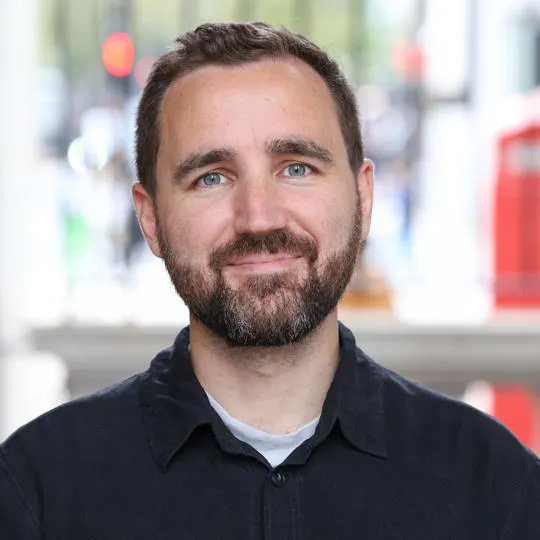
Lecturer in Digital Media and Culture
Senior Lecturer in Global Digital Cultures
Event details
FWB 1.11Franklin-Wilkins Building
150 Stamford Street London, SE1 9NH