
03 December 2025
Better Health & Care Hub highlights early innovation at King's Impact Reception 2025
In November, the Better Health & Care Hub showcased innovative work at the King’s Impact Reception 2025, an annual event celebrating the tangible difference King’s research delivers for people, the planet and society.

By 2035, around 36 million people in the UK, and 2.5 billion worldwide, will be living with more than one long-term health condition. Meeting this growing challenge requires bold ideas, cross-disciplinary collaboration and solutions that are affordable, scalable and rooted in real-world needs.
At the Hub stand, researchers, partners and King’s alumni explored ways to improve health and care for people with the most complex needs. This growing group are often overlooked in traditional healthcare systems, leaving them to face compounding challenges, from poorly coordinated care pathways to tools that are not built for everyday usability.
Guests saw how the Hub is helping reshape overstretched health and care systems by supporting cross-disciplinary projects that test bold ideas and drive practical innovation.
The stand highlighted three major themes:
- Building a resilient careforce: Discovering and testing new ways to strengthen the health and care workforce and to empower patients, carers and communities.
- Driving frugal innovation: Developing and evaluating affordable, scalable technologies that help people live well, especially at home and in their communities.
- Designing care with communities in mind: Сo-producing prototypes, care pathways and research methodologies that are shaped by the social, cultural and lived environments they must operate within.
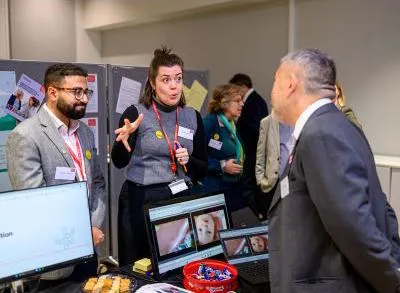
Activities at the Hub’s stand illustrated the practical promise of early-stage innovation. A rollator was used to spark conversations about redesigning mobility aids to be lighter, more stable and easier to store for people with advanced illness.
Wearable head cameras, demonstrated how researchers capture natural parent-child interactions at home, helping normalise observational mental-health research and improve data authenticity.
Frugal, non-drug interventions for chronic breathlessness were also shared from the SELF-BREATHE project, with simple handheld fans shown as a key evidence-backed device that can ease the sensation of breathlessness and reduce A&E visits.
Finally, the stand featured the Crafting Collaboration protype cards, which applies Elinor Ostrom’s Nobel Prize-winning insights on effective group working to improve how teams collaborate on health and care initiatives.
Through its three themes, the Hub acts as a connector across faculties and sectors. Philanthropic support plays a vital role in nurturing early ideas, encouraging collaboration and helping new approaches reach the people who need them most.
In this story

Director of Better Health & Care Hub

Centre Manager, Better Health and Care Futures

Postdoctoral Research Associate

Professor of Health Services Research & Rehabilitation

Lecturer in Child and Adolescent Mental Health

Adjunct Clinical Reader. Consultant Physiotherapist in Chronic Respiratory Disease

Vice Dean (Research & Impact) and Head of Division, Methodologies
Related departments
- Florence Nightingale Faculty of Nursing, Midwifery & Palliative Care
- Philanthropy & Alumni Engagement
- Philanthropy & Alumni Engagement
- King’s alumni
- Better Health & Care Hub
- Digital Health and Applied Technology Assessment
- Division of Methodologies
- Division of Care in Long Term Conditions
- Cicely Saunders Institute of Palliative Care, Policy & Rehabilitation