

Lina Kramer
PhD candidate
Research interests
- Economics
- Policy
Biography
Lina Kramer is a member of the Department of Political Economy at King's College London. Her research examines the intersection of artificial intelligence (AI) and social sciences. with a particular focus on how machine learning can support evidence‑based fiscal policy analysis and design. Her work evaluates both the opportunities and risks that AI technologies pose for modern fiscal governance.
She is funded by the UK Research and Innovation (UKRI) Economic and Social Research Council (ESRC) through the London Interdisciplinary Social Science Doctoral Training Partnership studentship award.
She holds an M.Sc. in Economics from the University of Cologne and a B.A. in Public Management and Governance from Zeppelin University. Prior to her doctoral studies, she worked for six years as a consultant supporting the digital transformation of the German public sector and federal administration.
Research Interests
- Fiscal policy, taxation, and government revenue
- Applications of machine learning in public policy
- AI-driven automation and its social, economic, and distributional impacts
- The dynamic interaction between economic inequality and redistributive policies
- Public opinion and political behaviour
- Climate policy and public support for climate-related fiscal measures
- Quantitative and computational methods
Doctoral research
Lina’s doctoral research investigates how machine learning can enhance fiscal policymaking while safeguarding democratic accountability. Her thesis consists of three components:
- A systematic review of machine learning in taxation research, analysing 217 studies using methods ranging from PRISMA to NLP to trace the evolution of ML applications in tax policy, forecasting, administration, and enforcement.
- Improving government revenue data quality and insights using machine learning, developing and evaluating ML-based imputation techniques for the Government Revenue Dataset (GRD) and using the resulting full dataset (1980–2022, 192 countries) to examine long‑term global trends in revenue levels and structures.
- A survey experiment on AI chatbots and fiscal climate policy opinions, assessing whether recommendations attributed to ChatGPT influence public support for fuel taxation and climate investment in Germany and the UK.
In addition to the thesis chapters, Lina has also explored the use of multi‑agent reinforcement learning (MARL) for tax policy design. This project investigated whether MARL could simulate and optimise tax systems by modelling interactions between economic actors under constraints such as growth, inequality, and welfare. While the project was not included in the final thesis due to methodological challenges and time constraints, it reflects Lina’s broader interest in computational approaches to fiscal governance and the potential of AI‑driven models for policy experimentation.
Supervisors
Research

Public Policy and Regulation Research Group
Public Policy and Regulation (PPR) is the home for theoretically and empirically grounded research which analyses policy and regulatory responses to important political, social and economic issues, and (individual-level) responses to these policies.

Comparative Politics Research Group
The Comparative Politics research group hosts a research agenda based on political institutions, representation and regimes.

Politics, Philosophy and Economics Research Group
The PPE research group studies questions spanning the disciplines of politics, philosophy, and economics.
News
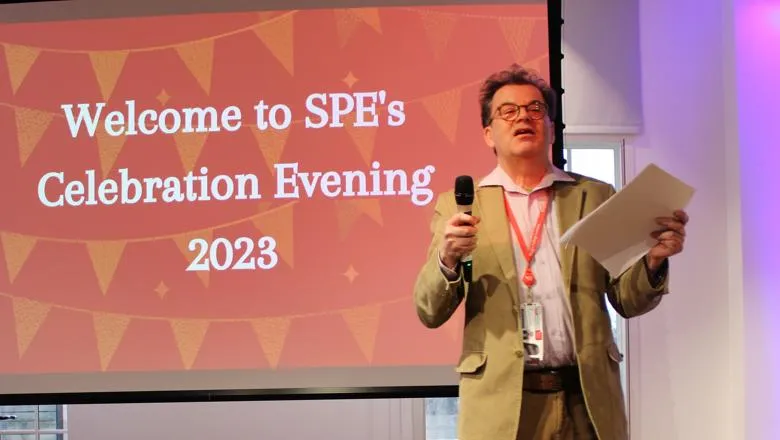
Staff and students honoured at annual awards
Outstanding students and staff from across the School of Politics and Economics (SPE) were honoured at an awards ceremony.
Features
Lina Kramer
Lina shares her experiences of her part-time PhD in public policy and machine learning, being President of the King’s Doctoral Students Association, and...

Research
Public Policy and Regulation Research Group
Public Policy and Regulation (PPR) is the home for theoretically and empirically grounded research which analyses policy and regulatory responses to important political, social and economic issues, and (individual-level) responses to these policies.
Comparative Politics Research Group
The Comparative Politics research group hosts a research agenda based on political institutions, representation and regimes.
Politics, Philosophy and Economics Research Group
The PPE research group studies questions spanning the disciplines of politics, philosophy, and economics.
News
Staff and students honoured at annual awards
Outstanding students and staff from across the School of Politics and Economics (SPE) were honoured at an awards ceremony.
Features
Lina Kramer
Lina shares her experiences of her part-time PhD in public policy and machine learning, being President of the King’s Doctoral Students Association, and...