

Biography
Dr Thiago Sogo Bezerra is a Lecturer in Physics in the Department of Physics, King’s College London.
He is an experimental particle physicist working on neutrino physics and new detector technologies, and a member of the Experimental Particle & Astroparticle Physics (EPAP) group. Before joining King’s, he was a Senior Research Fellow at the University of Sussex, and previously held posts at CNRS in France and, as a JSPS Postdoctoral Fellow, at the Research Centre for Neutrino Science, Japan. He holds a PhD in Particle Physics from Tohoku University, Japan.
Dr Bezerra has held leadership roles in major international collaborations, including NOvA, DUNE, JUNO, SNO+ and Double Chooz, where he was Analysis Coordinator. He is Simulation, Software and Reconstruction co-coordinator for the LiquidO-based AntiMatter-OTech project, and at King’s is developing AI methods for LiquidO opaque scintillator detectors. His work includes key measurements of neutrino oscillations and the development of new detector technologies (listed on INSPIRE-HEP), and his awards include the Physical Society of Japan Young Scientist Award and the Japan Association of High Energy Physicists Encouragement Prize.
Dr Bezerra is an Associate Fellow of the Higher Education Academy (AFHEA). Committed to public engagement, he co-developed a Royal Society-funded virtual-reality DUNE experience shown at the Summer Science Exhibition in 2024.
Research
- Neutrino oscillations
- Reactor antineutrino physics
- Novel opaque-scintillator detector technology (LiquidO)
- AI and machine learning for particle detectors and data analysis
Dr Bezerra’s research explores fundamental open questions about neutrinos: the ordering of their masses, the size of their mixing angles and whether neutrinos and antineutrinos behave differently. On the NOvA experiment at Fermilab, he developed cosmic-ray background estimates for the flagship oscillation analysis and a neural-network method to determine the neutrino mass ordering. In Double Chooz, he led the analysis behind the experiment’s most precise measurement of the mixing angle θ13, published in Nature Physics.
At King’s, Dr Bezerra is developing AI methods for LiquidO opaque scintillator detectors, spanning both software and hardware. These detectors trap light near where it is produced, giving detailed images of particle interactions. He is also joining the King’s Hyper-Kamiokande effort, the next-generation neutrino experiment in Japan.
Publications
- Precision measurement of neutrino oscillation parameters with 10 years of data from the NOvA experiment — NOvA Collaboration, Physical Review Letters 136, 011802 (2026)
- Muon tracking in a LiquidO opaque scintillator detector — LiquidO Collaboration, Journal of Instrumentation 21, P01010 (2026)
- Sub-percent precision measurement of neutrino oscillation parameters with JUNO — JUNO Collaboration, Chinese Physics C 46, 123001 (2022)
- Synergies and prospects for early resolution of the neutrino mass ordering — A. Cabrera et al., Scientific Reports 12, 5393 (2022)
- Neutrino physics with an opaque detector — A. Cabrera et al., Communications Physics 4, 273 (2021)
- Double Chooz θ13 measurement via total neutron capture detection — Double Chooz Collaboration, Nature Physics 16, 558–564 (2020)
Research
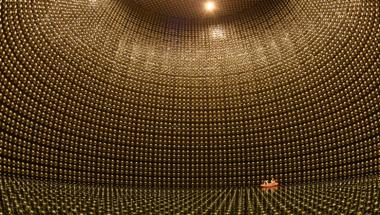
Experimental Particle & Astroparticle Physics
The aim of the EPAP group is to address some of the major open questions in our understanding of matter through the study of the nature of fundamental particles
Research
Experimental Particle & Astroparticle Physics
The aim of the EPAP group is to address some of the major open questions in our understanding of matter through the study of the nature of fundamental particles