
About the Group
Who are we?
The Psychometrics & Measurement Lab is directed by Dr Silia Vitoratou and mentored by Prof Andrew Pickles. Currently the lab hosts one NIHR doctoral fellow, four NIHR pre-doctoral fellows, two research assistants and a placement student. Nine undergraduate and one MSc student are also working at the lab under the supervision of Dr Vitoratou.
The Lab has offered and often advertises projects related to psychometrics for undergraduate and postgraduate IoPPN students, placement job positions, research assistant posts, and also hosts pre-doctoral, DClinPSy and PhD researchers.
What do we do?
Research
Research in the Lab focuses on the methodology and applications of psychometrics, psychological measurement, mathematical psychology, and social statistics. In the Lab, a multidisciplinary group of researchers with background in statistics, mathematics, psychology, psychiatry, and neuropsychology provides methodological support across the IoPPN and to external collaborators.
Methodologists affiliated with the Lab lead the statistical analysis in a number of important projects, some listed here.
The Lab initiated the Human AI Interaction workstream (Human AI Interaction Psychometrics Assessment Lab, HaI PAL) in 2026, which focuses on the development and standardisation of psychometric measurement instruments relating to all forms of Human-AI interactions.
The Lab also initiated the Misophonia Clinical Academic Research Group (mCARG).
The Lab unites researchers across King’s College London who work in psychometrics through the IoPPN Psychometrics Community. If you are affiliated with the College and your research involves psychometrics (developing PROMs or PREMs or other psychometric scales, applying or developing latent variable models and relevant software), or you are interested in the field in general, you are welcome to join our community by enrolling to our webpage on KEATS.
Human–AI Interaction Psychometrics & Assessment Lab (HAIPAL)
The Human–AI Interaction Psychometrics & Assessment Lab (HAIPAL) is a dedicated research stream within the Psychometrics and Measurement Lab (PML), facilitating the development and standardisation of psychometric tools across all forms of human–AI interaction. Based at the Institute of Psychiatry, Psychology & Neuroscience (IoPPN), King’s College London, HAIPAL provides the methodological and statistical infrastructure required to evaluate how artificial intelligence reshapes human cognition, mental health, and social behaviour.
From Capturing a Vanishing Benchmark to Shaping the Future
We are operating within a narrow, non-stationary window of observation. A substantial portion of the global population does not yet use artificial intelligence, while those who do, still remember a world entirely without it. This transition makes capturing baseline measurements an urgent priority: in just a few years, an unassisted human baseline will cease to exist. Consider, for example, how psychological dynamics will shift as conversational agents move from basic text interfaces to multimodal, hyper-personalised, and deeply anthropomorphic social companions. HAIPAL was created to address two methodological priorities:
-
Baseline and Longitudinal Tracking: Creating measurement tools capable of recording early, contemporary human–AI interactions, while remaining able to be calibrated for longitudinal tracking as architectures evolve.
-
Anticipatory Research Projects: Answering the question: what will we wish we had measured today? Designing projects around the effects of AI on important clinical outcomes before the natural reference point is permanently lost.
Conversational Agents and Mental Health Psychometrics (CAMP)
CAMP is a research programme within HAIPAL, dedicated to developing validated outcome batteries for the evaluation of how conversational agents alter mental health trajectories, symptom management, and cognitive autonomy across both clinical and non-clinical populations.
Just as cars reduced everyday walking without replacing our need for physical health, artificial intelligence confronts us with the delegation dilemma of what cognitive tasks to outsource versus preserve. Our research maps this balance by examining both adaptive scaffolding (where AI acts as an empowering prosthetic against daily stress) and functional erosion (where overreliance risks atrophying unassisted problem-solving and emotional resilience).
Within this framework (offloading-scaffolding-erosion) our team is currently working at pace to deliver validated psychometric tools to examine the impact of conversational AI on the clinical presentation, everyday cognitive support, and daily functioning of individuals with autism and ADHD.
Open Call for Collaborators: New measurement tools are needed to capture the ongoing effect of AI across all phenotypes. We invite researchers working on other clinical disorders, cognitive profiles, or psychological traits to contact us to co-develop and validate specialised instruments.
Teaching
Apart from offering a substantial number of BSc, MSc and DClinPsy projects, we teach
- Latent variable modelling (term 2, MSc in Applied Statistical Modelling & Health Informatics)
- Introduction to Research Methods (term 1, MSc of Affective Disorders, MSc in Clinical Neuroscience).
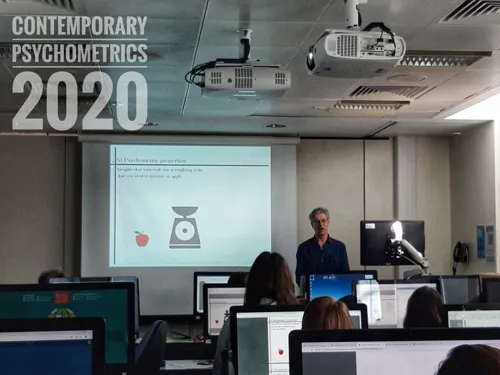
- Introduction to Psychometrics (term 2, MSc of Affective Disorders).
Silia also teaches seminars in applied psychometrics to the DClinPsy programme and the BSc Psychology programme.
Consultancy services and collaborations
Our lab is welcoming collaborations within KCL as well as with other institutions and research groups in the UK and abroad. We can participate in three kinds of funded projects (subject to staff availability and in accordance with the college-set fees of services):
- Consultancy services (co-authorship not expected): we offer expert advice for projects and proposals related to psychometrics and measurement.
- Research support services (co-authorship is expected): if your research project needs the support of a psychometrician to conduct the analysis, we might be able to help.
- Grant submission: Our team welcomes collaborations for grant submissions in research projects related to psychometrics and measurement (costings to be agreed per project)
IoPPN Psychometrics and Measurement Database
The IoPPN Psychometrics and Measurement Database is a web database application, which lists all publications regarding psychometrics and measurement, in which at least one of the authors is affiliated with the IoPPN. Our aim is to bring together the array of contributions the Institute has made to the field of psychometrics and further promote research.
Visit the Database
If you have developed a measure, which could be included in the database, please contact Dr Silia Vitoratou.
Please find a short tutorial on how to use the IoPPN Psychometrics and Measurement Database below.
The application has been developed by Engr. Ebaneo Valdez Kao For enquiries please contact ebanvk@gmail.com.
The application has been developed by Engr. Ebaneo Valdez Kao For enquiries please contact ebanvk@gmail.com.
Advisory service
The PML provides a Psychometrics Advisory Service to staff and students, from all IoPPN departments free of charge. This service is intended to provide initial project advice and technical support with carrying out a research project. Statistical support is provided in the following areas:
- Developing a psychometric scale
- Item response theory models
- Exploratory and Confirmatory factor analysis
- Reliability and Validity Assessment
- Measurement invariance (multiple groups, multiple conditions)
- Interpretation and presentation of results
- Queries by statistical referees
- Statistical software (SPSS, Stata, Amos, R, Mplus)
All students planning a research project are encouraged to seek the advice of the academic staff. Permission must be obtained by MSc students from their project supervisors to attend this service. MSc Students are limited to two 30 min appointments for the academic year. PhD/Staff are limited to three 30 min appointments a year, which may be booked in succession, if a longer appointment than 30 min is required. All bookings must be made at least 48hrs in advance. During busy periods, you may have to wait 2-3 weeks for an appointment. The Biostatistics and Health Informatics Department will not provide last minute assistance.
Terms and conditions: Failure to attend the Advisory Service without sufficient notice, (2 working days) or a valid reason, will render you ineligible for future appointments with our Advisory Service.
For actual timings see the online booking site.
Acknowledgements
These webpages represent independent research part funded by the National Institute for Health Research (NIHR) Biomedical Research Centre at South London and Maudsley NHS Foundation Trust and King’s College London. The views expressed are not necessarily those of the NHS, the NIHR or the Department of Health.
Group lead

Reader in Psychometrics and Measurement