

Waste & circularity
There's no time to waste... Put rubbish in its place!
The environmental impacts of waste go beyond carbon emissions - it extends to depletion of natural resources if recyclable materials are not recovered. Ecosystems can also be damaged if waste is disposed of incorrectly or illegally.
As a University, we produce a significant amount of waste through our campus operations, including our offices, restaurants, residences and laboratories. Currently we manage 24 separate waste streams with the greatest volume being general waste, mixed recycling and clinical waste.
We have both a legal responsibility and shared commitment to ensure our waste is managed in the most sustainable way possible. Our waste and resources targets aim to tackle this directly, prioritising systems change to reduce waste from both procurement to enabling a circular approach.
Students and staff at King's can support us in achieving these targets by reducing waste, and ensuring they use the correct bins on campus. To support this, we have developed a Waste A-Z which explains how common types of waste can be recycled on campus.
Our waste and recycling targets, data and initiatives are reported publicly through our annual Sustainability Report.

“Avoid and reduce waste at source and manage residual waste according to the hierarchy, enabling circularity of materials.”
Recycling: Mixed recycling is sent to a Material Recovery Facility (MRF), where it is sorted into the different recycling waste streams. Food waste: Food waste is measured through the data provided by our waste contractor, and treated at an anaerobic digestion plant, which turns food waste into biogas and fertiliser. King's Food also work to reduce food waste occurring on campus. General waste: General waste is sent to an Energy from Waste (EfW) plant, where waste is burnt and the energy created from this is put into the electricity grid. Furniture: Staff are encouraged to place these items onto Warp It, a furniture donation platform internal to King's.
Read more about King’s Food’s work to reduce food waste on campusRead more about furniture donation on Warp It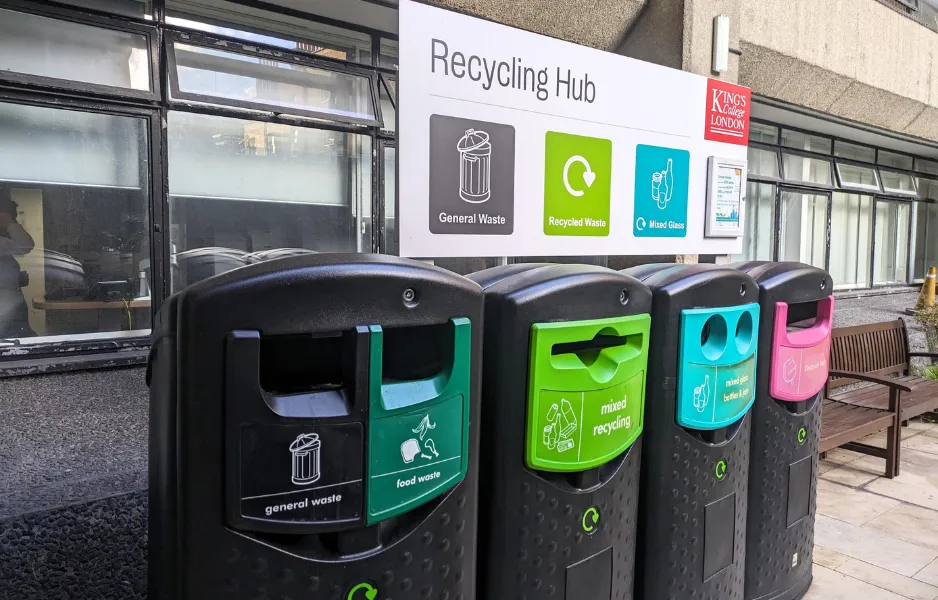
We’re working to improve our recycling rates and reduce waste contamination. To do this, it is essential that all waste is put into the correct bin. When items are disposed of incorrectly, this contaminates the bin, and can lead to all contents in mixed recycling and food waste bins having to be disposed of as general waste, leading to higher emissions, reduced circularity, and increased resource use.

There's no time to waste... Put rubbish in its place!

A resource to help you reduce waste on an and off King's campus

Find out more about the King's waste hierarchy

Empowering our students to shape a more sustainable future.

Mobilising King’s research and expertise to respond to the climate crisis.

Building sustainability into King’s actions and operations.

Learn more about how you can join in with King's sustainability activities.