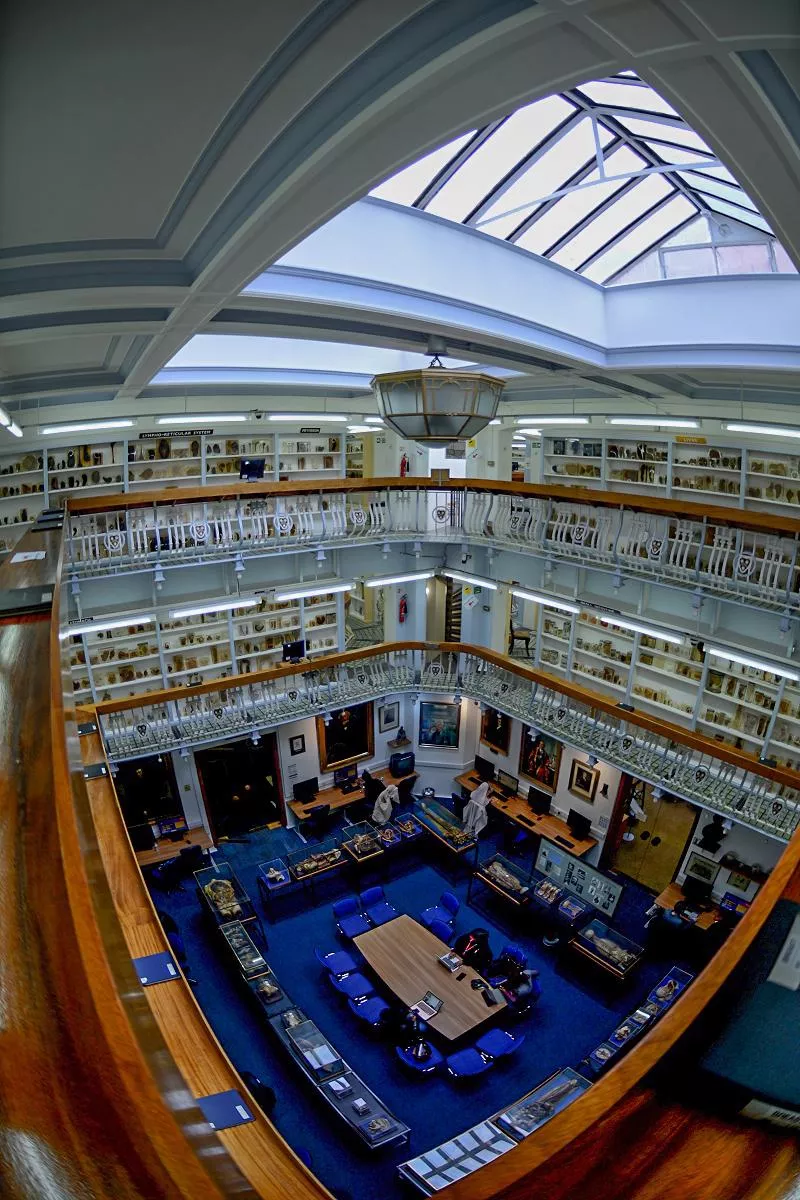
King’s Gordon Museum of Pathology is the largest medical museum in the UK and contains some rare and unique artefacts including Lister’s antiseptic spray and the original specimens of kidneys, adrenal glands and lymph nodes which led Richard Bright, Thomas Addison and Thomas Hodgkin to describe the medical conditions that bear their names.
The Museum’s primary function has always been to help train medical, dental and biomedical students and professionals to diagnose disease and as such it provides a range of services and functions to The School of Medicine and to medical professionals. The Museum supports the studies of over 9,500 current healthcare students.
Housed in the Museum are also a number of important historic collections. The Joseph Towne anatomical and dermatological wax models, the Lam Qua pre-operative tumour paintings and the specimen and artefact collections of Hodgkin, Thomas Addison, Bright and Astley Cooper. All of these are on permanent display throughout the Gordon Museum.
King’s Gordon Museum of Pathology is one of the largest pathology Museums in the world and teaching is its primary function.
The Museum intranet (24 terminals) contains pathological CAL programmes and a specimen database. Video players are available in all rooms.
The Percy Roberts' Room on the ground floor is arranged as a lecture theatre, which can hold up to 65 people. The Dunhill and Joe Daws Anatomy Rooms provide tutorial and meeting areas and the Aesculapius room can be used for multiple tutorials, smaller meetings and occasional reading areas. Data projection, 35mm slide and overhead projection and a projection microscope are available, as is some bookable computer space. Students are also able to use the Museum as a study facility – where the resources for dental and medical science learning are rich and comprehensive.
The Museum encourages learning from the past in order to impact positively on contemporary and future healthcare developments. Currently in development is the creation of a digital media archive and teaching resource available as a state of the art teaching aid, to use in situ.
King’s College staff can book teaching areas of the Museum and exhibition space is also available for use.

The Human Tissue Act (HTA)
The Human Tissue Act (HTA) 2004 created the requirement for licensing of premises involved in the storage of human tissue for future (unspecified) research and introduced standards for obtaining explicit consent from tissue donors and for exercising control over the storage and subsequent use of the retained tissues. The Gordon Museum of Pathology is run in concordance with the HTA requirements and is not open to the public.
Access to the Museum is permissible to the following personnel on production of an appropriate ID card
- GKT staff, students and Graduates
- Staff employed by Guy's and St Thomas' Hospital Trust
- Staff and students of the Nightingale School
Access is allowed to the following people by arrangement
- Members of the Medical and Dental professions
- Nursing, Radiography, ODP and Physiotherapy staff and students of other Medical Colleges and trusts
- Medical historians
To make an appointment to visit the Museum please contact Bill Edwards for more information - details in the sidebar.