Based in the heart of London, King’s is spoilt for choice with a range of internationally significant, world-class museums and galleries within a stone’s throw. You will have face-to-face encounters with works of art that have expressed and inspired religious devotion. The conversations fostered in King’s between theologians, curators, art historians and artists give unparalleled insight into the vividly material dimensions of religious belief and practice, not just in the past but in the present.
A great diversity of religious groups and organisations, ancient and new, have also made London their home. During your course you will have the opportunity to visit many of these. We visit St. Paul’s Cathedral to learn about its history, the Freemason’s Hall, headquarters of the United Grand Lodge, to assess its religious credentials, and a number of the synagogues, mosques, churches, Buddhist temples and other religious communities that inform your modules, helping you to relate the theory of the lecture hall to the realities of lived religion.
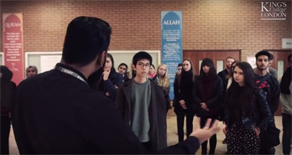

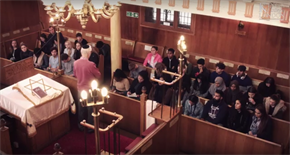
Students visit the East London Mosque Students visit the historic Sandy's Row Synagogue Prof. Ben Quash teaching students about St Paul's Cathedral
Quotes from participating students:
In regards to the temple trip, I would say that seeing it in person helped make sense of the theoretical teachings and as it was such a memorable trip, what I learned on that day stuck in my head, hence why I chose to revise the sima [Buddhist ritual enclosures] as one of the topics for the exam.
I had been to the British Museum several times before, but focusing on each object gave me a new insight. It was interesting to see how those objects are related to each other.
It is amazing to study religion in London, where there are so many different cultures and faiths literally on your doorstep. Our class visits helped me to relate the course materials to the real world and really brought my studies to life. London is such a diverse city and my TRS modules help me understand what's going on beneath the surface.
AKC programme
The AKC (Associateship of King’s College) is the original award of the university, dating back to its foundation in 1829 and reflecting its first motto: ‘sancte et sapienter’ (with holiness and wisdom). Its innovative lecture series in philosophy, ethics and religion focuses on topical issues, and is at the heart of the university's commitment to an international, interdisciplinary curriculum. AKC series are curated by King's TRS staff and feature experts from across the university. Over 3000 students and staff from all departments and faculities follow the AKC every year.
AKC lectures enrich and broaden the academic curriculum at King’s in a unique way, encouraging students to learn about multicultural London, the UK, and the world. The AKC offers an inclusive, research-led programme of lectures that give all King’s students the opportunity to explore diverse cultural perspectives, alongside their main programme of study. In recent years, AKC lecture series have focused on migration, mental health, leadership, London, and ethics in cultural context.
Watch a sample AKC lecture:
The Department awards several different prizes to students who have excelled academically or shown substantial progression from one year to the next.
These prizes include:
- Hanson Prize for Philosophy of Religion (£100) Awarded annually to the MA student with the best examination results in the study of Philosophy of Religion.
- Hanson Prize for Christian Ethics (£75) Awarded annually to the MA student with the best examination results in the study of Christian Ethics.
- McCaul MA Prize (£200) Awarded annually to the MA student with the best examination results in the study of the Old Testament.
- Relton Prize for Christian Doctrine (books to the value of £60) Awarded annually to the MA student gaining the highest marks in the study of Christian Doctrine.
- Shelford MA Prize (£250) Awarded annually to the MA student who has shown the best performance in the study of Religion.
- Ulrich Simon Prize (£75) Awarded annually to the MA student with the best overall performance in an MA within the Department of Theology & Religious Studies.