Over the past 15 years, neurodegenerative diseases have become the leading cause of death worldwide, and the number of cases continues to rise in the UK. There are still no effective treatments for the neurodegenerative diseases that cause dementia, and many questions remain as to the root causes.
Dementia refers to a set of symptoms that may include memory loss or difficulties in thinking, problem-solving or language. There is a common misconception that dementia is a normal part of ageing. Dementia only appears when our brains are impaired by neurodegenerative diseases. These diseases cause a loss of functions in brain cells. While these diseases mostly affect the older population, they can also affect younger individuals.
The most known neurodegenerative diseases include Alzheimer’s Disease (AD), Frontotemporal Dementia (FTD) and Amyotrophic Lateral Sclerosis (ALS). In ALS, systems that control muscles are impaired, which affects movement, breathing and swallowing.
The UK Dementia Research Institute (UK DRI) is the single biggest investment the UK has ever made in neurodegenerative diseases, thanks to £290 million from founding funders the Medical Research Council, Alzheimer’s Society and Alzheimer’s Research UK. Revolutionary in scale and scope, and with collaboration at its core, the UK DRI brings together diverse expertise across seven centres nationally to accelerate the discovery, development and delivery of interventions that will help diagnose, treat and ultimately prevent dementia.
The UK DRI at King's College London opened in August 2017 and is led by Centre Director Professor Jernej Ule. The mission of our centre is to understand the earliest molecular and pathophysiological events that initiate neurodegeneration and develop novel therapeutic strategies.
Our major disease interest is on ALS, FTD, and AD. Although distinct in the areas of the nervous system affected, these diseases do share common clinical pathological features. Our research looks at the similarities and differences between these diseases to find the keys to slow or halt loss of brain cells at the earliest stages.
UK DRI at the Maurice Wohl Clinical Neuroscience Institute
Our centre is located within the Maurice Wohl Clinical Neuroscience Institute. The institute is home to the Wohl Cellular Imaging Centre, the world’s only Nikon Centre of Excellence in Advanced Neuroscience Imaging. This includes an N-STORM microscope that can simultaneously measure the movement of two single molecules at high speed with super-resolution, which has enabled ground-breaking analyses of disease-related RNA-binding protein transport across individual nuclear pores.
The centre also has access to the proteomics and genomics facilities at King’s that includes Nanopore long-read sequencing workflows and the King's Brain Bank with over 3,000 cases, as well as the platforms and technologies available across all UKDRI Centres. Only by addressing the issues we see in these patients can we develop appropriate biomarkers and therapies for dementia.
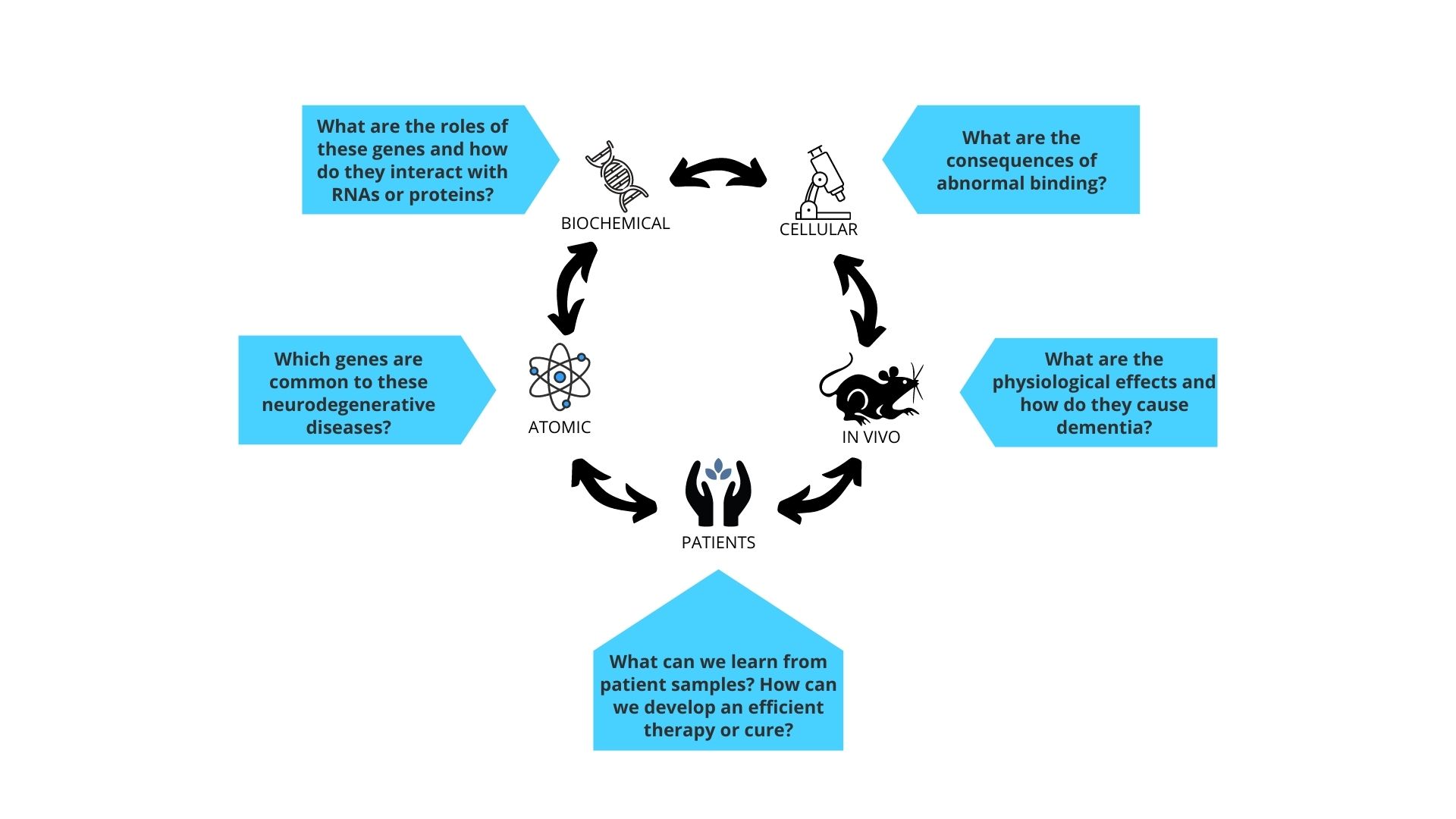
Our key questions
- Which cell types are vulnerable to the genetic and environmental variables that drive ALS/FTD?
- What role does disrupted RNA regulation and energy metabolism play in the shared pathomechanisms?
- Can we understand the causes of the aggregation and toxicity of key RNA-binding proteins via their altered RNA binding, liquid-liquid phase separation and nucleo-cytoplasmic transport?
- Can we therapeutically target the shared pathomechanisms across genetic and sporadic forms of disease?
- Can we enhance endogenous neuroprotective pathways for novel therapeutic approaches?
The six UK DRI Group Leaders and their research focuses
- Professor Jernej Ule (Centre Director): Modulaton of protein–RNA complexes in in neurodegeneration
- Professor Chris Shaw: Gene discovery and gene therapy
- Dr Marc-David Ruepp: Altered RNA metabolism in neurodegeneration
- Dr Sarah Mizielinska: Nucleocytoplasmic transport dysfunction in FTD and ALS
- Dr Sarah Marzi: Epigenetic regulation in neurodegenerative diseases
- Dr Andrea Serio: Bioengineered platforms to model neurodegeneration in single cells and circuits
'Between the signals' podcast
UK Dementia Research Institute at King’s College London has launched a new podcast, ‘Between the signals’ which is aimed at bringing greater understanding about neurodegenerative conditions, and the groundbreaking research going into treating them to a public audience.
You can now watch on YouTube or listen via the following podcast platforms.