
Creative Majority
The All Party Parliamentary Group (APPG) for Creative Diversity
The APPG for Creative Diversity was formed in May 2019 by Ed Vaizey MP (now Lord Vaizey) and subsequently chaired by Chi Onwurah MP, with Baroness Deborah Bull as Co-Chair. The group has currently paused activities, but its members remain committed to the group’s mission and to finding effective ways to tackle obstacles to equality, diversity and inclusion in the creative sector.
In common with all APPGs, it brought together members of both Houses and all political parties. From the Commons, members included Helen Grant MP, Rupa Huq MP, Kim Johnson MP, Marsha De Cordova MP and Giles Watling MP. Lords members included Baroness Floella Benjamin, Baroness Jane Bonham-Carter, Lord Ed Vaizey and Baroness Gail Rebuck. Secretariat was provided by Alex Pleasants, formerly Ed Vaizey’s senior policy adviser, and Joanna Abeyie MBE, diversity consultant and CEO of Blue Moon.
Over the last five years, the APPG undertook two collaborative research projects, with a research team including academics from King’s College London’s Department of Culture, Media and Creative Industries in the Faculty of Arts & Humanities.
The research culminated in the publication of two significant reports focussing on ‘What Works’ to support, encourage and improve equity, diversity and inclusion in the creative sector.
Speaking about the university’s partnership with the APPG, Beatrice Pembroke, Executive Director, King’s Culture, said:
"King’s is proud to have worked with the APPG for Creative Diversity and this influential group of partners to uncover tangible ways we can ensure a more just and inclusive creative workforce, starting with more sustainable and equitable entry paths into the sector, including the vital role of Higher Education. This research should be seen as a call-to-action, as the findings clearly show that efforts to widen participation and pathways into HE are currently not resulting in a more diverse workforce. I hope that the vital recommendations will help provide a useful guide for those with the power to make the necessary structural changes – from policymakers and creative organisations to businesses and educational institutions - that will have long lasting impact that benefits us all."
Creative Majority: An APPG for Creative Diversity report on ‘What Works’ to support, encourage and improve equity, diversity and inclusion in the creative sector
This report examines ‘What Works’ to improve diversity and inclusion in the workplace, from fields as diverse as medicine, science, technology, engineering, maths, education, and management studies. It draws on evidence submissions and roundtable consultations, as well as a review of the academic literature brought into dialogue with lived experiences and examples of effective action within the creative and cultural sector.
The research team for the Creative Majority report was made up of Dr Dave O’Brien (University of Edinburgh/AHRC Policy & Evidence Centre), Dr Natalie Wreyford and Dr Tamsyn Dent (King’s College London) and Jenny Butterfield (University of Edinburgh).
The research team were further assisted by a scientific committee that included: Professor Sarah Atkinson; Dr Roberta Comunian; Dr Virginia Crisp; Dr Joanne Entwistle; Dr Jonathan Gross and Dr Wing-Fai Leung from the Department of Culture, Media & Creative Industries and Dr Ruvani Ranasinha from the Department of English, Faculty of Arts & Humanities, King's College London; Beatrice Pembroke, Executive Director, Culture, King’s College London, and Hilary Carty, Director of Clore Leadership.
The research and report were generously supported by King’s College London, University of Edinburgh, Paul Hamlyn Foundation and NBC Universal. Support was also received from the AHRC Policy & Evidence Centre, the Creative Industries Federation and Marie Claire.
Key recommendations
The Five As
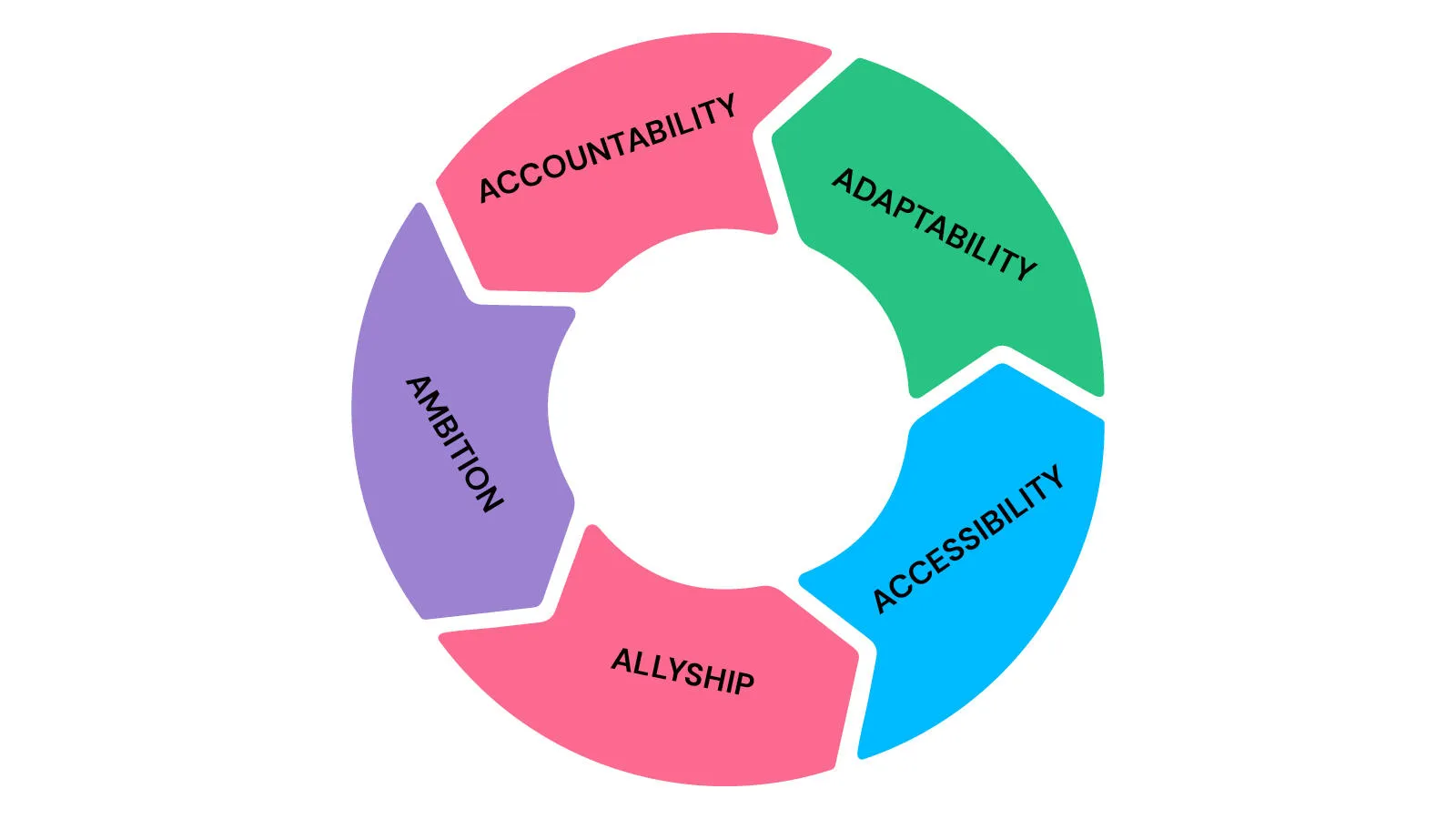
The report is organised around five headline guiding principles that provide a framework for current effective practices in recruiting, developing and retaining a diverse creative sector. These five As should act as benchmarks for anyone wanting to see results in equity, diversity and inclusion (EDI).
- Ambition reflects the need for EDI to be addressed by everyone, at every level, and put at the heart of business, funding and commissioning plans.
- Allyship provides the conditions for EDI to flourish and ensures all voices are heard.
- Accessibility provokes questions about who is not able to participate and why.
- Adaptability provides practical tools for the application of effective practices.
- Accountability promotes ways to ensure change happens, lessons are learned and shared, and actions are adapted accordingly.
The five are complemented by 26 policy recommendations. These recommendations offer methods to transform the creative industries into a more equitable, diverse, and inclusive sector of our economy and society. The policy recommendations also offer a challenge, to businesses, policymakers, the creative sector, and to society, to work together in leading creative diversity in the creative economy.
Introducing the report, the Chair of the APPG for Creative Diversity, Chi Onwurah MP, said:
For too long the UK’s creative industries have been dominated by a narrow subset of the UK population – a subset that does not represent our country as a whole. The pandemic has only deepened this issue, with fewer creative organisations, fewer job opportunities and fewer openings for diverse talent. Without action, we risk exacerbating inequalities further in the creative industries and an entire generation of talent – the future of the sector – could be lost. Creative Majority shows how we can plot a positive course out of this crisis. It is the culmination of 18 months of research by the APPG for Creative Diversity and its partners into what works – and what doesn’t – when it comes to boosting diversity and inclusion in the creative sector. The result is a comprehensive report that provides actionable, practical steps for creative businesses and organisations, as well as achievable recommendations for government.
Baroness Deborah Bull, Co-Chair, said:
The report calls for greater ambition, allyship, accessibility, adaptability and accountability: five As that, taken together, provide a framework for good and effective practice and benchmark standards against which businesses can measure progress. The first of these As is the sine qua non. Change will only happen if equality, diversity and inclusion are not left to any one individual or team but are understood as the responsibility of everyone, at every level of every creative organisation: firmly rooted at the heart of business, funding, engagement and commissioning plans. Change at this scale will require bold and visionary leadership across government, at sector level and within organisations and businesses: leadership that is willing to step up to meet the challenge this report sets out. It won’t be easy, but the rewards will be great: a creative workforce and audiences that include, represent and benefit from the talents of the full and glorious diversity of the UK population.
Making the creative majority
The APPG’s second research project focussed on ‘What Works’ to support diversity and inclusion in creative education and the talent pipeline, with a focus on the 16+ age category.
The report identifies critical points for intervention for the creative industries, education providers and policymakers to ensure the UK’s creative industries are inclusive and equitable.
The core research team was made up of Professor Roberta Comunian, Dr Tamsyn Dent and Dr Natalie Wreyford from the Department of Culture, Media & Creative Industries, Faculty of Arts & Humanities, King’s College London, alongside Professor Dave O’Brien from the Department of Art History and Cultural Practices, School of Arts, Languages and Cultures, University of Manchester. They were supported by Tessa Read from Creative Shift, Academic Enhancement at University of the Arts London, Dr Mark Taylor from the Sheffield Methods Institute, University of Sheffield, Professor Sarah Jewell, University of Reading and post-doctoral researchers Dr Atif Ghani (University of the Arts London), Dr Ruth Brown, Dr Kate Shorvon, Scott Caizley, Aditya Polisetty and Yolanda Tong Wu (King’s College London) and Dr Sonkurt Sen (University of Bonn).
The research and report were generously supported by King's College London, University of the Arts London, University of Manchester and the Creative Industries Policy & Evidence Centre (Creative PEC), YouTube and Paul Hamlyn Foundation.
Launching the report, Chi Onwurah MP, Chair of the APPG, wrote:
This APPG report’s findings illuminate not just the challenges but also the opportunities that lie ahead. The underrepresentation of individuals from global majority backgrounds, the clear class crisis, and gender disparities highlight an urgent call to action. This report critically sets out ‘What Works’ to begin building a more equitable creative education system for those aged 16+ and to dismantling the obstacles facing the next generation of creative talent. If we are to remain a creative nation, systemic change is not just necessary but absolutely vital.
